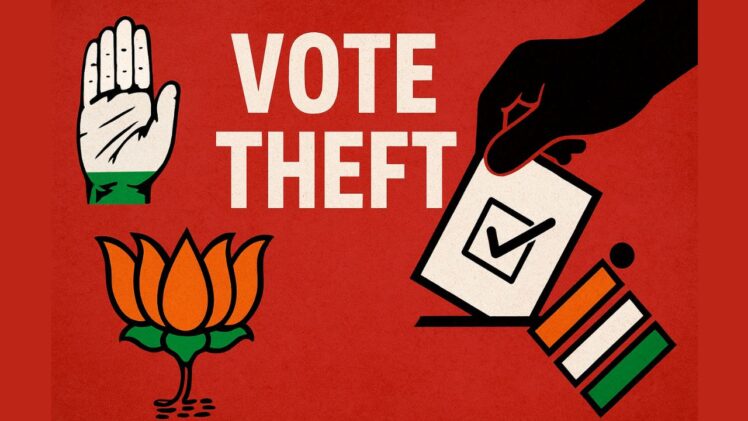
In India’s charged political arena, the Indian National Congress (INC) has accused the Bharatiya Janata Party (BJP) of orchestrating ‘vote theft’—a grave allegation that strikes at the very heart of the country’s democratic process and raises urgent questions about the fairness and transparency of elections.
For those unfamiliar with the details, this article aims to provide a clear and concise overview of the key issues at play.
There are a number of allegations put forth by the Congress party, but the central claim is that the BJP has engaged in systematic manipulation to influence election outcomes. This alleged manipulation is not a simple matter of rigging ballot boxes, but a more sophisticated and insidious process that undermines the democratic foundation of the country. One of the main points of contention is the use of Electronic Voting Machines (EVMs). The Congress party and other opposition groups have repeatedly expressed concerns about the security and tamper-proof nature of these machines. They argue that EVMs could be susceptible to hacking or manipulation, allowing for a pre-determined outcome that does not reflect the will of the voters. These concerns have been amplified by instances where the votes recorded on EVMs did not match the votes cast, although the Election Commission of India (ECI) has consistently dismissed these claims as unfounded.
The Core Allegations: Manipulation of Voter Rolls
Central to the Congress’s claims is the assertion that the BJP has engaged in systematic manipulation of voter lists across the country. Rahul Gandhi, a prominent leader of the Congress, has described this as a “huge criminal fraud” carried out in alleged collusion with the Election Commission of India (ECI). This is a grave charge, as it questions not only the actions of a political party but also the impartiality and integrity of a constitutional body responsible for safeguarding the democratic process.
The primary component of this alleged fraud involves the deliberate inclusion of fake or duplicate voters in electoral rolls. The Congress claims that these fraudulent entries are strategically added to constituencies where they could potentially swing the election in favour of the BJP. The argument is that by artificially inflating the number of voters who are likely to support the ruling party, the BJP can secure victory even in tightly contested races. This alleged strategy goes beyond mere political campaigning and touches upon a fundamental violation of the “one person, one vote” principle that forms the basis of a fair democratic system.
To support their claims, the Congress party has presented specific examples. One such instance involves an analysis of voter lists in the Mahadevapura assembly constituency in Karnataka. According to the party, this analysis, conducted by its research team, revealed over 100,000 suspicious entries. These entries, they allege, fall into several categories of irregularities: duplicate voters, voters with invalid or fake addresses, bulk registrations at a single address (such as a single apartment or building being the registered residence for an improbably large number of people), and voters with invalid photographs. The Congress argues that this is not an isolated incident but rather a widespread pattern occurring in various states, including Maharashtra, and may have significantly impacted the results of numerous Lok Sabha (parliamentary) seats. The party has launched a dedicated campaign to highlight these issues and demand accountability.
ECI Responds
The accusations have led to a heated public exchange. The Election Commission of India has responded by challenging Rahul Gandhi to submit a signed declaration or an affidavit to back his claims, a demand that Gandhi has rejected. The ECI has stated that it has a robust system in place for voter registration and deletion, and that any discrepancies should be brought to its notice through the proper channels. For its part, the BJP has vehemently denied all allegations, calling them a “vote chori” campaign by a party that is unable to accept its electoral defeats. The BJP has also counter-alleged that the Congress itself has engaged in similar practices in its own strongholds. This complex and serious political dispute raises questions about the transparency of the ECI’s data, the process of voter roll management, and the overall trust in India’s electoral system.
The Challenge of Non-Machine-Readable Data
Adding to their concerns, the Congress has heavily criticised the Election Commission of India (ECI) for allegedly providing voter list data in a non-machine-readable format. This crucial point of contention highlights a significant obstacle for political parties and civil society organisations attempting to ensure the integrity of the electoral process. The non-machine-readable format, which often means the data is provided in a scanned PDF or image format, makes it exceedingly difficult and time-consuming for political parties to conduct thorough, large-scale audits of the electoral rolls. It prevents them from using sophisticated software or data analysis tools to cross-reference entries, identify duplicates, or flag suspicious patterns. Consequently, verifying the authenticity of the millions of registered voters becomes a monumental, if not impossible task.
The party argues that this lack of accessible and transparent data fundamentally hinders their ability to effectively identify and challenge potentially fraudulent entries. In a system where voter manipulation is a central allegation, the inability to systematically examine the voter rolls is seen as a deliberate impediment to a fair check-and-balance mechanism. Without the ability to run a quick digital check, parties are left to the cumbersome and error-prone method of manual verification, which is not a feasible solution for an electorate of over 900 million. This lack of transparency, according to the Congress, serves to protect the very irregularities that they are attempting to expose.
Consequently, the Congress and other opposition parties are strongly advocating for the immediate provision of digital voter rolls that can be easily analysed. They propose that the ECI should provide this data in a standard, searchable format, such as a spreadsheet or a database file, which would enable all stakeholders to perform their own independent audits. This would not only empower political parties to verify the rolls but would also enhance public trust in the electoral system. They believe that providing such data is a necessary step towards ensuring full transparency and accountability in a democratic system, and that the ECI’s reluctance to do so raises serious questions about its commitment to impartiality. The demand for machine-readable data is therefore not just a technical issue, but a critical component of the larger debate about the fairness and integrity of India’s elections.
ALSO READ:
Echoes of 1972, Shadows of 2025: What History Tells Us About Power in Meghalaya
Scrutiny of Close Electoral Contests
The Congress party has also intensified its focus on the results of several closely contested Lok Sabha seats in the recent elections, adding another layer to their “vote theft” allegations. According to reports, Rahul Gandhi has stated that the party is specifically examining approximately 70 seats where they suffered narrow defeats, with margins of less than 50,000 votes. This targeted scrutiny is a strategic move, as it aims to connect their broader allegations of voter list manipulation with concrete, quantifiable outcomes. The party’s core suspicion is that the alleged inclusion of fraudulent entries and the deletion of legitimate voters may have played a decisive, and perhaps the sole role in these close contests.
The argument put forth by the Congress is that a systematic manipulation of even a small percentage of voters in a constituency can have a disproportionately large impact on the final result, especially when the victory margin is slim. For instance, in a constituency where the winning margin is just a few thousand votes, the alleged addition of fake voters or the removal of opposition-leaning voters could be enough to tip the scales. The party believes that the sheer number of these closely contested seats points to a deliberate and coordinated strategy by the BJP to secure victories in constituencies that would have otherwise gone to the opposition.
This focus on narrow defeats also serves a rhetorical purpose, as it provides a tangible narrative for the party’s claims. By highlighting specific seats and presenting the vote counts, the Congress is attempting to move the debate from abstract accusations of fraud to a more concrete discussion of how the alleged irregularities directly impacted the election results. They are building a case that these 70+ seats are not a coincidence but are symptomatic of a larger, more systemic problem. This analysis, if it provides compelling evidence, could significantly bolster the party’s claims and increase public pressure on the Election Commission of India to address their concerns. The Congress is essentially asking for a re-examination of the results in these seats, arguing that the true will of the people may have been suppressed in favour of a manipulated outcome.
Congress’s Campaign and Demands
In response to these grave allegations, the Congress party has launched a multifaceted public campaign to raise awareness about what they term “vote chori” (vote theft). The campaign is a deliberate effort to move the issue beyond political rhetoric and into the public consciousness, creating a narrative that the integrity of the electoral process itself is under threat. A central component of this strategy is the creation of a dedicated online portal, votechori.in, designed to serve as both a platform for information and a tool for mobilizing public support.
The portal provides a digital repository for what the party claims is “proof” of electoral fraud, including analysis of voter lists and video presentations by prominent leaders like Rahul Gandhi. It allows citizens to register their backing for the Congress’s core demand: that the Election Commission of India (ECI) release digital, machine-readable voter rolls for public scrutiny. To make the campaign more interactive, the portal offers a feature where supporters can register their opposition to “vote chori” and receive a personalised digital certificate, complete with the signatures of top party leaders. This element is designed to give supporters a sense of direct participation in the campaign and encourages them to amplify the message on social media.
Furthermore, the INDIA (Indian National Developmental Inclusive Alliance), a coalition of opposition parties that includes the Congress, has announced and carried out plans to stage a protest march to the ECI’s office. This physical demonstration is a significant escalation, transforming the protest from a virtual campaign into a direct confrontation with the institution at the centre of the controversy. The protest, which saw MPs from various opposition parties marching from Parliament, was designed to exert direct public pressure on the ECI. The protesters, carrying placards with slogans like “SIR + Vote Theft = Murder of Democracy,” aimed to visually and vocally express their collective frustration with the electoral process and the ECI’s perceived inaction. This joint action signifies a rare moment of unity among the opposition parties and underscores the seriousness with which they view the allegations, framing the issue as a collective fight to protect the foundational principles of Indian democracy.
The Response from the ECI and BJP
The Election Commission of India (ECI) has not remained silent in the face of the Congress’s accusations. It has vehemently denied the claims, labelling them as “fake” and “misleading” in its public statements. The ECI has positioned itself as a neutral, professional body and has taken a firm stand against what it views as an attempt to erode public trust in its operations. In a particularly notable move, the ECI challenged Rahul Gandhi to provide a formal declaration under oath to substantiate his claims of a “criminal fraud.” This demand was not just a procedural formality; it was a strategic challenge designed to put the onus of proof squarely on the Congress party, suggesting that their claims were baseless unless backed by a legally binding affidavit. Gandhi, for his part, declined this demand, asserting that he has already taken an oath to the Constitution of India and that his public statements should be considered sufficient. This exchange has created a standoff, with the Congress refusing to provide what the ECI sees as the necessary proof, and the ECI maintaining that its systems are transparent and secure.
Meanwhile, the Bharatiya Janata Party (BJP) has launched a robust counter-offensive, accusing the Congress of attempting to undermine democratic institutions and the credibility of the ECI, particularly after a series of electoral losses. The BJP’s narrative is that the Congress, unable to accept defeat, is resorting to a “disinformation campaign” to discredit a fair electoral victory. The BJP has repeatedly called the Congress’s claims a “loser’s lament” and a sign of the party’s desperation. To further deflect attention from the current allegations, the BJP has brought up historical instances of alleged electoral malpractices by the Congress party itself. They have cited past examples of controversies surrounding voter lists and booth capturing during previous eras of Congress rule, seemingly to argue that the opposition’s current moral high ground is hypocritical. This counter-narrative serves a dual purpose: it aims to delegitimize the Congress’s claims while simultaneously framing the BJP as the protector of India’s democratic values, which are allegedly under attack from a disgruntled opposition. This has resulted in a heated political battle where both sides are not just debating electoral integrity, but also trading accusations of undermining the very system they claim to be defending.
Diverse Perspectives and the Way Forward
It’s crucial to acknowledge that in a country as vast and populous as India, the issue of voter list discrepancies is viewed through diverse lenses, with some analysts offering perspectives that differ from the political accusations. Some electoral experts and demographers suggest that many of the irregularities, such as multiple individuals registered at the same address or duplicate entries, could be attributed to a complex mix of demographic and social factors rather than deliberate fraud. For instance, India’s large internal migrant population, which frequently moves from rural to urban areas for work, often utilises temporary accommodations like single rooms or shared housing for voter registration, leading to a high number of individuals officially registered at the same, often small, address. Similarly, large joint families living under one roof could also contribute to multiple, legitimate entries at a single location. These analysts argue that while such instances warrant scrutiny, they may not necessarily be evidence of a deliberate, large-scale criminal conspiracy. This perspective adds a layer of complexity to the debate, suggesting that some of the issues raised might be structural challenges inherent to managing a colossal voter database in a dynamic society.
The allegations made by the Congress party, however, are undoubtedly serious and strike at the very heart of the democratic process. Regardless of the underlying causes, the public’s trust in the integrity of the electoral system is at stake. The Election Commission of India (ECI), as the constitutional body responsible for conducting free and fair elections, faces the crucial task of addressing these concerns transparently and effectively. Its response will not only shape the current political discourse but will also have long-term implications for public confidence. To move forward, the ECI could consider a multi-pronged approach: not only continuing its public defense of the current process but also undertaking a more visible and proactive campaign to audit and clean up the voter rolls. Engaging with political parties, civil society organizations, and independent experts in a collaborative and transparent manner could be a key step.
The ongoing debate underscores the paramount importance of maintaining the integrity of electoral rolls and ensuring that every eligible citizen’s vote is accurately counted. As the situation unfolds, further investigation and dialogue will be necessary to either validate or refute these claims. This could involve independent, third-party audits of the voter databases, an open forum for all political parties to present their evidence, and a public commitment from the ECI to implement any necessary reforms. Ultimately, upholding the trust of the Indian populace in the electoral system is a shared responsibility, and a resolution to this controversy will require a commitment to transparency and accountability from all stakeholders involved.