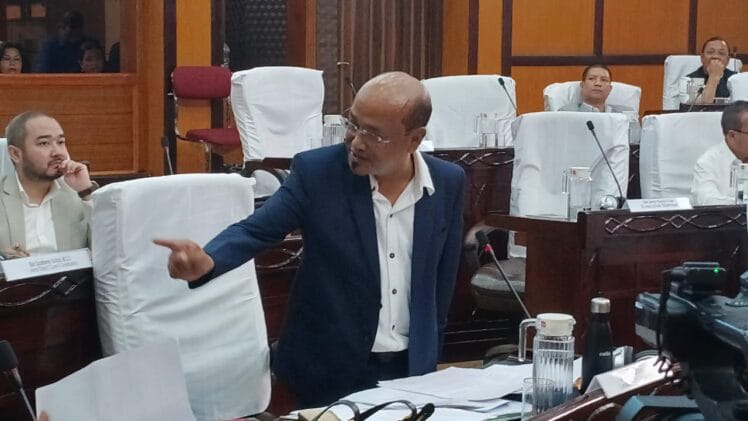
SHILLONG: During the budget discussion in the Khasi Hills Autonomous District Council (KHADC), leader of the opposition Titosstarwell Chyne expressed deep concern over the Executive Committee (EC) presenting a deficit budget this year, pointing out that the Council had managed a surplus budget just last year.
Chyne questioned the sudden financial shift within a year, especially since the ruling side had previously claimed to be cutting down on non-essential expenditures.
He alleged that unwarranted spending must have taken place to push the Council’s finances into a deficit.
Turning his attention to the KHAD Regulation and Administration of Land Act, the opposition leader raised serious questions regarding the newly introduced amendments.
He noted that while the initial objective of ‘Land Saving’ was meant to prevent the indiscriminate sale of Raid (community) lands to the government, individuals, or businessmen, the current amendment compromises this protection.
Chyne strongly objected to the deletion of the phrase “after prior consultation with the respective Dorbar” from Section 16 of the Act. He reminded the House that the District Council does not own even an inch of land, as all territories belong to the traditional Himas, Raids, and private owners (Ri Kynti).
By stripping away the requirement to consult the Dorbar Shnong and Himas before issuing official notifications, the EC is directly hurting the core sentiments of the Khasi community and diluting an Act that was meant to codify and safeguard indigenous land rights.
Furthermore, Chyne questioned the insertion of Section 8, which introduces digital sessions, the Unique Land Parcel Identification Number (ULPIN), and land surveys. He demanded clarity on whether ULPIN is tied to central government schemes, warning that any central interference could pose a major threat to the community.
He also sought an immediate response from the EC on whether it is prepared to contribute its mandatory 20% matching share to access the 80% Basic Performance Grant from the 16th Finance Commission of India.
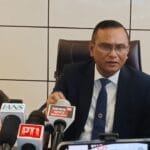
In response to the opposition’s criticisms, Executive Member in-charge of Finance, Seiborlang Rynjah, explained that budget structures naturally fluctuate from year to year depending on revenue collection, and a surplus cannot be guaranteed every term.
Citing findings from the Comptroller and Auditor General (CAG) report, Rynjah explained that there has been a significant decline in the Grant-in-Aid released by the Government of India to the KHADC through the state’s District Council Affairs (DCA) department.
Despite this acute financial crunch, Rynjah highlighted that the EC made a historic move by enhancement of salaries for long-serving casual employees of the Council. He also addressed the lack of manpower in other sectors, noting that although the KHAD Waste Management Act 2020 was approved in 2022, the Council has been unable to hire permanent staff due to tight finances, leaving the department to function with just the members of the Solid Waste Management Cell.
Defending the land policy amendments, Rynjah stated that changes were necessary to keep pace with changing times, acknowledging that modern reforms often face initial resistance. He firmly denied that the deletion of the consultation clause was an attempt to hijack or curtail the powers of the Rangbah Shnong, Dorbar Shnong, Hima, or Raid.
Instead, he maintained that the ‘Land Saving’ initiative aims to bring absolute clarity, efficiency, and proper system regulation. He emphasized that the Council needs to modernize and strengthen its Land Department using contemporary technology and experts, which requires substantial funding.
Rynjah concluded by reassuring the House that the introduction of the Digital India Land Record Modernization Programme and ULPIN is purely aimed at improving, securing, and properly documenting land records with financial support from the Central Government.