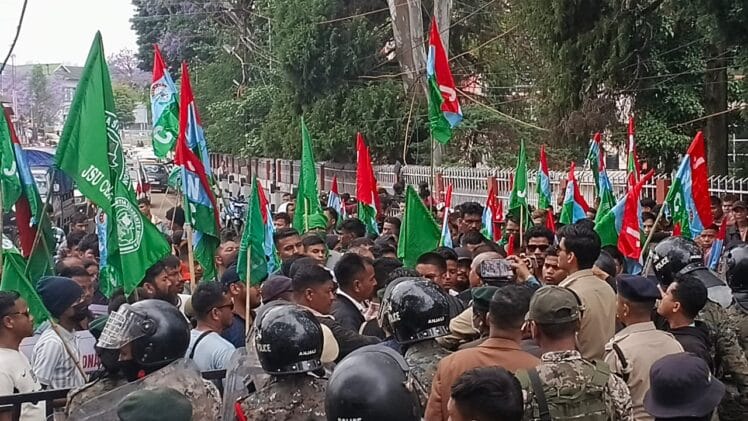
SHILLONG: Members and leaders of the Jaintia Student Union (JSU) and the Jaintia National Council (JNC), along with the residents of Daistong village in East Jaintia Hills, gathered in large numbers to voice their vehement opposition against the proposal to conduct a public hearing on May 22 at Lum Syrman village.
This public hearing marks a step by the government to permit the Shree Cement company to mine limestone in the East Jaintia Hills district, a move that has triggered immense concern and deep anger among the local indigenous population and pressure groups.
Earlier this morning, the protestors initially assembled at Malki Ground and from there, they organized an orderly foot march, proceeding toward the Civil Hospital area and onward to the IGP Monument.
However, when they attempted to march forward toward the Secretariat, police forces blocked their path by setting up barricades, reinforced by a heavy deployment of security personnel.
Because their route was obstructed, the leaders of the pressure groups and the local residents held discussions with the district administration and subsequently decided to hold their first public meeting right at that spot to make their voices and demands heard.
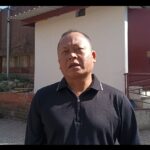
During this meeting, the senior leaders and residents strongly condemned the MDA Government for its lack of seriousness regarding this issue, which directly impacts future generations and the environment.
They dissected and critically examined the Environmental Impact Assessment (EIA) report, pointing out that it contains instructions and guidelines originating from the Gujarat SEIAA that pertain to a project in Gujarat, which were instead adopted and borrowed for the project proposed to be set up in Meghalaya.
The leaders questioned how the Terms of Reference (TOR) prepared by the SEIAA of the Gujarat Government could apply to the State of Meghalaya, and they noted that the EIA failed to give due space to the District Council, relying instead on laws that are either dead or completely outdated.
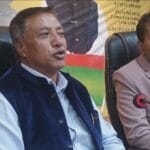
JNC President Sambormi Lyngdoh expressed severe concern over the disaster management plan intended to mitigate environmental damage, alleging that the plan is obsolete and utilizes seismic standards that have already been scrapped.
Consequently, they demanded and insisted that there must be full approval and endorsement from the Khasi Hills Autonomous District Council (KHADC) through the specific rights and powers guaranteed under the Sixth Schedule of the Constitution of India, asserting that no environmental regulations can be imposed without strictly adhering to the rules and provisions contained within the constitution.
The leaders recalled that Shree Cement began purchasing land last year and in doing so, violated the Land Transfer Act, which had prompted them to write to the Government to express their grievances, though no serious action was taken and the Government proceeded to push through with the Public Hearing by force.
The protestors clarified that their clear stance now is that the agitation is not directed against Shree Cement but is aimed squarely at the MDA Government, arguing that if the Government could cancel the project at Lumpondeng, it must also withdraw this project in Daistong, and if the Government tramples upon the rights of the people, they will have no choice but to campaign against the Government in the upcoming MP by-election.
The pressure groups and residents sharply criticized the Jaintia Hills Autonomous District Council (JHADC), labeling it the weakest council of all because the Chief Executive Member (CEM) had recently stated clearly on the floor of the house that he was pressured by the State Government to issue a No Objection Certificate (NOC) to cement factories in that region.
Therefore, they strongly urged the MDA Government never to interfere with the independent functioning of the district council, as the Council possesses its own distinct constitutional powers to protect the indigenous land and resources.
In concluding the meeting, the leaders warned that they would hold another gathering and return to express their opposition, declaring that they would no longer tolerate a system of governance that mirrors the rule of the mafia.