SHILLONG: The ambitious expansion of the Shillong–Pynursla–Dawki road, once envisioned as the crown jewel of Meghalaya’s infrastructure, has devolved into a haunting narrative of loss and negligence. What should have been a conduit for economic growth and seamless connectivity is now widely feared as a “death trap,” a chilling reputation earned through a series of horrific accidents that have claimed at least ten lives since 2023.
The promise of a modern highway has been buried under the weight of falling stone and unstable earth, turning a daily commute into a lethal gamble for the local population.
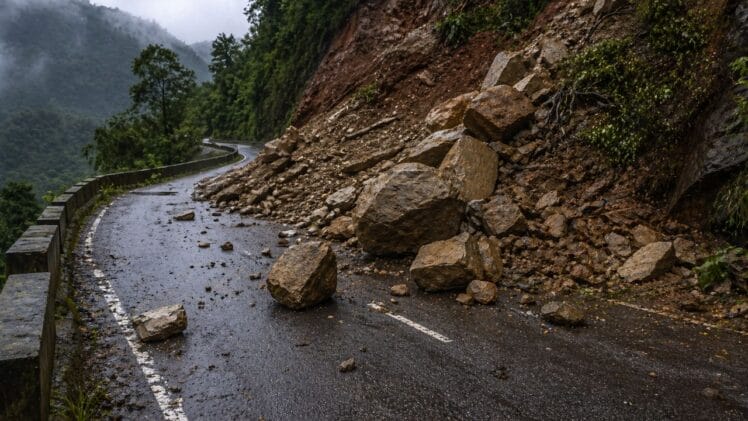
The gravity of this crisis reached a breaking point on April 20, 2026, at Mawlieh. In a moment of sudden, violent devastation, massive boulders dislodged by aggressive hill-cutting crushed a Mahindra Bolero Camper. The vehicle’s occupants, Wanbor Nianglang and Nangteibor Khongthohrem, were merely returning home from a routine grocery run to Shillong when the mountain gave way.
Their instantaneous deaths have left the community paralyzed by grief and served as a grim reminder of the instability defining the Package 2 stretch of the project. This was not a freak accident but the latest entry in a harrowing timeline: two deaths in 2023 were followed by a catastrophic event in 2025 that wiped out five members of a single family, including an infant.
The recurring landslides at notorious hotspots like Mawlieh, Lyngkyrdem, and Rngain have ignited a firestorm of public indignation. Civil society organizations, spearheaded by the Hynñiewtrep Youths’ Council (HYC), have pointed the finger directly at the National Highways and Infrastructure Development Corporation Limited (NHIDCL) and its contractors.
HYC President Roy Kupar Synrem has been vocal in accusing these entities of a “blatant disregard for human life,” pointing to a systemic failure to implement even the most elementary safety measures. The absence of proper barricades, clear demarcations, adequate lighting, and professional traffic management suggests a construction environment where speed has been prioritized over the survival of the citizenry.
This outcry has moved from the streets to the halls of justice, as the HYC filed a public interest letter petition before the Meghalaya High Court. The petition seeks to hold the State Government, the NHIDCL, and the Public Works Department (PWD) legally accountable for what are described as criminal lapses in safety standards. The core of their argument is simple yet profound: infrastructure must serve the people, not sacrifice them.
The legal action demands an immediate, comprehensive road safety audit and a radical overhaul of construction protocols, especially given that the project’s completion is still nearly two years away.
Under intense pressure, the government has shifted into a defensive mode. Deputy Chief Minister Prestone Tynsong recently announced the temporary closure of the most hazardous sections, finally acknowledging that the current terrain is fundamentally unstable.
The proposed solution involves fresh land acquisition to facilitate more extensive slope stabilization, a move many locals view as a belated response to a long-foreseen danger. While the NHIDCL has promised to halt work at critical sites during the upcoming monsoon and has engaged experts for a vulnerability study, the sense of security has already been shattered. For the residents of Pynursla and Dawki, the road remains a fragile and lethal landscape, where every journey is overshadowed by the fear that the earth might move once more.