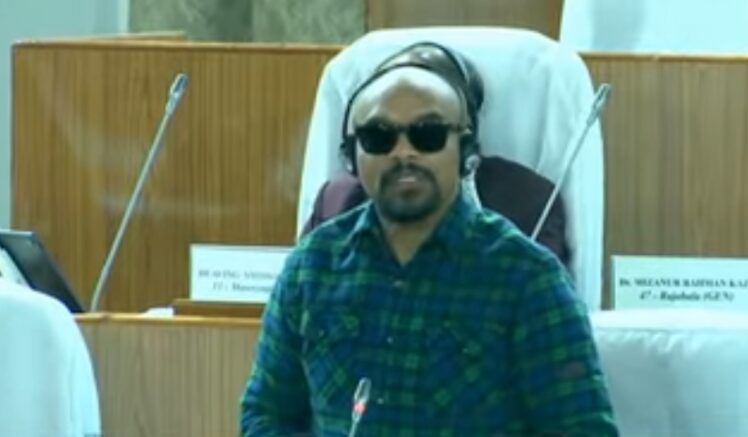
SHILLONG: In a high-stakes discussion regarding the Expert Committee’s report on the State Reservation Policy, Voice of the People Party (VPP) leader Ardent Miller Basaiawmoit today urged the Meghalaya Legislative Assembly to bypass “judicial apprehension” and increase the job reservation for the Khasi-Jaintia community to 47%.
Speaking before the August House, Basaiawmoit expressed the “great shock” felt by the people of the Khasi-Jaintia region following the committee’s recommendation to maintain the status quo of the 1972 policy.
He argued that the current framework fails to account for the significant population disparity and the mounting unemployment pressure facing Khasi youth.
Addressing concerns of communal friction, the VPP leader clarified that the demand for a review is not an attempt to infringe upon the rights of the Garo community.
“When we asked the government to review, we were not asking to take away the rights of our Garo brothers and sisters,” Basaiawmoit stated.
He proposed a “middle path” where the 40% quota for the Garo community remains untouched, while the Khasi-Jaintia quota is raised from 40% to 47% to better reflect their population, which he described as “almost double” that of their counterparts.
Basaiawmoit took aim at the Expert Committee’s fear that changing the policy might fail judicial scrutiny. He reminded the House that the legislature holds the power to craft laws and that courts rarely interfere in policy matters unless there is a clear legal breach.
He pointed out that the 1972 policy was designed with a “carry forward” limit of only one year for vacant posts, intended to maintain administrative efficiency.
However, he argued that the recent introduction of the roster system has complicated this flexibility, creating a rigid environment that now necessitates a formal percentage increase to ensure “just and fair” representation.
A significant portion of Basaiawmoit’s submission focused on the dangers of the roster system. He issued a stern warning to the government against implementing the roster retrospectively, suggesting that doing so could jeopardize the careers of those already employed under previous interpretations of the policy.
“Should we wait for the court to decide?” Basaiawmoit asked. “The court did not question the policy; the court questioned the absence of a roster. If the government decides to increase the quota by 7%, it will ease the huge pressure on our educated youths.”
The VPP leader called on the state government to demonstrate unprecedented political will. He noted that during his extensive travels in the Garo Hills, many residents expressed that their primary fear was a reduction in their own quota—a fear his proposal specifically avoids.
“This government will be remembered by the youths of the state if it takes a bold decision where no government in the past has had the courage to do it,” he concluded.