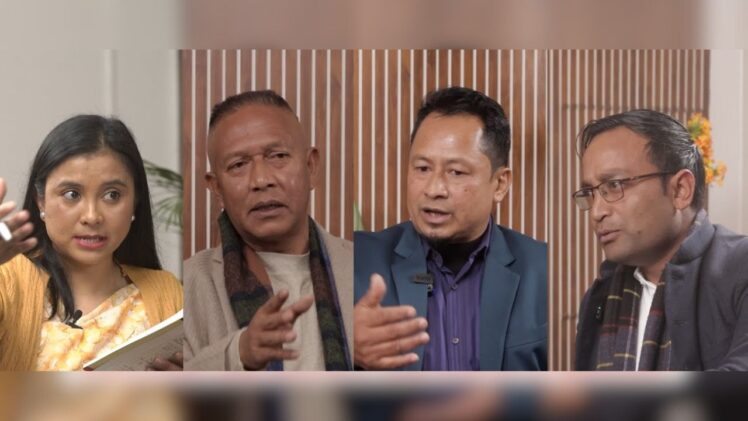
SHILLONG: A sharp exchange on the failure to implement existing laws, the demand for Inner Line Permit (ILP), and the growing concern over illegal immigration dominated a recent panel discussion — titled Rynsan Iathir involving political leaders and activists in Meghalaya. Organised by 4Front Media, the panel of speakers unanimously pointed to a lack of political will as the core obstacle in protecting the state’s indigenous population.
Raising the issue of laws like Immigrants & Foreigners’ Act (I&FA) and the Meghalaya Residents Safety and Security Act (MRSSA), 4Front Media Editor, Ibankyntiew Mawrie questioned why these provisions have failed to deliver results on the ground.
Responding strongly, President of the Hynniewtrep Youth Council (HYC) Roy Kupar Synrem alleged that successive governments, both at the state and national levels, have deliberately avoided implementing these laws for electoral gain.
“Let’s be honest—who gave these people a place to stay if not the government (Congress) that ruled this state and country for decades before the BJP?” Synrem said. He claimed that illegal settlers were allowed to remain because they translate into votes, adding that eviction drives have been seen only in the last decade.
“I am not saying that the BJP is doing this because of the goodness of their heart but they also have their own agenda because we are all aware that majority of the people in India belong to one particular religion,” he said, sharply.
Synrem further alleged that both national parties — Congress and BJP have pursued politics of convenience.
“Whether in Garo Hills, Assam or West Bengal, what we are seeing is vote-bank politics. The laws are there, but they don’t want to implement them because more settlers mean more votes,” Roy Kupar Synrem said.
The discussion then turned to Chief Minister Conrad K Sangma’s recent mention of ILP-like provisions as a possible solution. Secretary of the Coordination Committee on International Border (CCIB) Kmen Myrchiang argued that ILP remains the only effective safeguard for indigenous communities. “ILP is the only act that can truly protect us. In Khasi-Jaintia Hills, ILP will ensure strict monitoring of who enters and who leaves the state,” he said, urging the state BJP to press Union Home Minister Amit Shah for its immediate implementation.
ALSO WATCH DISCUSSION ON ILP IN KHASI:
Questioning the delay, Ex-IPS Officer and Meghalaya BJP Spokesperson M. Kharkrang said he is not privy to the discussion between the state and the centre on this issue, adding that the reasons were unclear. “If ILP can be granted to Manipur, why not Meghalaya?” he asked, suggesting that Meghalaya’s status as a transit state may be cited by the Centre as a hurdle. However, Myrchiang countered that the real issue was the absence of political will. He also expressed concern over social vulnerabilities, alleging that in coal belt areas of the Jaintia Hills, such as Khliehriat and Lad Rymbai, inter-community marriages between local women and Bangladeshi immigrants—some of whom have been residing in the area for as little as five to six months—have further complicated the situation.
An interesting exchange followed when Synrem confronted Kharkrang, questioning how leaders within or close to the government could claim ignorance. “Politics in Meghalaya is funny. You are part of the system but say you don’t know what the government is doing. There are BJP MLAs and even a minister in the state—why can’t they convince the Government of India?” Synrem argued, adding that transit concerns could be addressed through exemptions while regulating those who intend to settle.
Clarifying his position, Kharkrang said his lack of information was personal, not reflective of party leadership.
Furthermore, Synrem reiterated that businessmen-driven governance, dependence on cheap labour, and lack of unity among leaders and political parties have weakened Meghalaya’s ILP demand. “Some go to Delhi demanding ILP, others oppose it. There is no consistency,” he said.
On alternative mechanisms in the absence of ILP, Synrem proposed structural reforms, including renaming the Border Areas Development Department to a Border Areas Security or Affairs Department to focus on border management. He stressed strict action against facilitators of illegal entry, greater involvement of village defence parties (VDPs) and border villagers, strengthening Dorbar Shnongs, and continuous monitoring of illegal settlements, including in Shillong.
ALSO WATCH FULL DISCUSSION IN KHASI:
Myrchiang criticised the Autonomous District Councils, accusing them of wasting time on politics instead of using their powers to monitor and protect indigenous interests.
Kharkrang cautioned that ILP alone is not a foolproof solution, citing Arunachal Pradesh where illegal settlement persists despite ILP. Referring to Assam’s eviction drives and large-scale detection of illegal Bangladeshis in metropolitan areas like Mumbai, he warned that Meghalaya faces an imminent threat due to its proximity to Bangladesh.
“If we don’t act now and go after the real facilitators, not just small players, the consequences will be severe,” Kharkrang said.
The discussion concluded with a shared concern that without decisive action, strict enforcement of laws, and genuine political commitment, Meghalaya’s demographic and indigenous security could face irreversible damage.