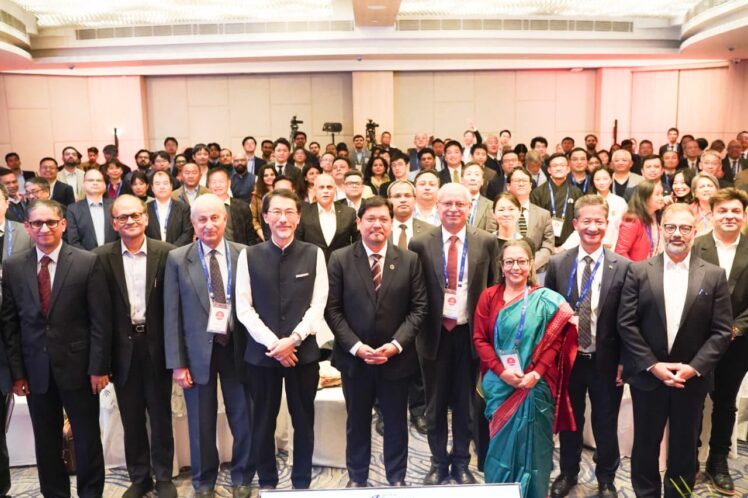
SHILLONG: The Sixth India–Japan Intellectual Conclave “Kizuna” was inaugurated on Thursday at Vivanta, Shillong, reaffirming deepening strategic, economic, and cultural cooperation between India and Japan, with Meghalaya emerging as a key gateway for engagement in the Northeast.
Chief Minister Conrad K. Sangma, attending as the Chief Guest, emphasized that India–Japan relations are rooted in mutual respect, democratic values, and a shared commitment toward sustainable development and economic collaboration.
Describing the theme “Kizuna”—meaning a lasting bond—as symbolic of the enduring partnership between the two nations, Sangma stated that Meghalaya’s collaboration with Japan extends beyond infrastructure to people-centric development and long-term capacity building.
The inaugural session was also attended by Ambassador of Japan to India Keiichi Ono, N.J. Gangte, Secretary & OSD (Establishment), Ministry of External Affairs and Acting DDG of ICWA, and Takuro Takeuchi, Chief Representative of JICA India, along with diplomats, policymakers, and industry stakeholders.
Highlighting employment partnerships, the Chief Minister informed that 47 nurses from Meghalaya are currently working in Japan, reflecting growing mobility opportunities for skilled professionals.
Following his Japan visit in April 2025, the state signed an MoU with ASEAN One Co. to train and place 500 youth in Japan this year, with plans to scale placements to 5,000 youths over the next five years. Meghalaya has also partnered with NAVIS HR to facilitate overseas employment opportunities.
To further strengthen workforce readiness, a Japanese Language Training Centre has been established in Shillong to equip local youth with linguistic and professional skills required for international placement.
Sangma highlighted a major milestone in agricultural collaboration, noting that India’s first commercial production of shiitake mushroom blocks is underway in Upper Shillong with technological and marketing support from Japan’s YATS Co.
The facility, capable of producing 1.5 lakh inoculated shiitake blocks annually, is expected to benefit over 1,000 farmers across Meghalaya. The state is also exploring the production of locally brewed sake using indigenous rice varieties in collaboration with Sasaki Sake Brewery of Japan.
Acknowledging Japan International Cooperation Agency (JICA) as a longstanding development partner, the Chief Minister said JICA-supported initiatives are transforming infrastructure, forestry, and livelihood sectors in Meghalaya.
Under the MegLIFE Project, nearly 22,500 hectares of forests across 500 villages in 11 districts are being restored while improving rural livelihoods.
He further noted that renovation works at the Umiam Hydro Power Station and Umiam-Umtru Stage-III Hydroelectric Project are being undertaken with JICA assistance. The agency is also funding the nearly 19-km Dhubri–Phulwari river bridge, set to become India’s longest river bridge linking Assam and Meghalaya.
With 74% of Meghalaya’s population below 35 years, Sangma proposed the creation of a Meghalaya–Japan Skill Corridor, combining the state’s youthful workforce with Japan’s technological expertise.
The Chief Minister also highlighted cultural exchanges, noting that the Shillong Cherry Blossom Festival has hosted dedicated Japanese pavilions over the past two years, showcasing Japanese cuisine, traditions, and performances.
Inviting Japanese businesses and academic institutions to collaborate further, Sangma identified priority sectors including climate resilience, circular economy, sustainable tourism, agriculture, and technology.
He concluded by thanking the Embassy of Japan, the Ministry of External Affairs, and Asian Confluence for organizing the conclave, describing it as a “living bridge” strengthening engagement between Japan and India’s Northeast.
Earlier, the Chief Minister toured exhibitions featuring artefacts from the Imphal Peace Museum and the North East Archives.