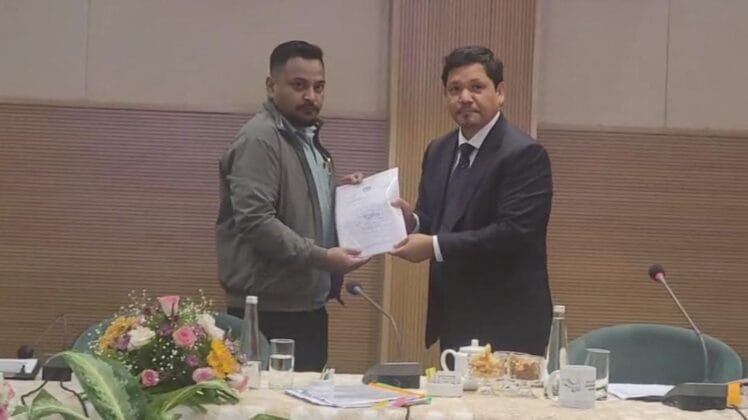
SHILLONG: In a major political development, the Central Executive Committee of the Khasi Students’ Union has formally presented a exhaustive twenty-point memorandum to Chief Minister Conrad K. Sangma, demanding a radical overhaul of Meghalaya’s governance, security, and socio-economic policies.
Meeting the Chief Minister on Wednesday, the high-level student delegation warned against bureaucratic inertia and made it clear that they would aggressively track the progress of their demands across all relevant government departments.
At the forefront of the union’s grievances is the accelerating rate of illegal migration into Meghalaya, which they attribute to recent eviction drives targeting illegal settlements in West Bengal and Assam.
To shield the state’s indigenous populations from demographic displacement, the union is pushing the state government to confront the Centre more aggressively for the implementation of the Inner Line Permit system. In the interim, they are demanding the immediate operationalization of the Meghalaya Residents Safety and Security Act.
The student body noted with bitterness that the legislation has languished for a decade because state panel advocates failed to legally defend and justify the establishment of entry and exit facilitation centers before the High Court of Meghalaya.
Tied directly to these anti-influx demands is an unyielding embargo on state railway projects and uranium mining in the South West Khasi Hills, both of which the union vows to oppose through extreme measures until foolproof border mechanisms are active.
Identity, land protection, and territorial integrity formed another core pillar of the discussions. The delegation pressed for the constitutional recognition of the Khasi language via the Eighth Schedule and demanded a presidential amendment to the Constitution (Scheduled Tribes) Order of 1950 to remove outside tribal groups from Meghalaya’s recognized list, a loophole they claim allows non-residents to illegally exploit local land-transfer laws.
Turning to the volatile inter-state boundary dispute with Assam, the union expressed dissatisfaction with the first phase of resolution, arguing that an equal division of the disputed territory failed to recognize historical facts and indigenous chiefdoms.
For the highly sensitive second phase, which includes sectors like Langpih, Border, and the Block areas, they demanded that ethnic contiguity and the explicit willingness of residents dictate the final alignment.
The memorandum launched a scathing attack on institutional corruption and nepotism within the state’s employment machinery. To ensure a fair playing field for local youth, the union called for the total abolition of personal interviews for all Grade B non-gazetted, Grade C, and Grade D recruitment processes, pointing out that personality assessments are unnecessary for clerical and operational roles.
While acknowledging that some recommendations from the 2025 MPSC Reform Committee have been adopted, they demanded full compliance to stop applications from general residents of India for jobs meant strictly for state citizens. District Selection Committees also came under heavy fire for alleged rampant corruption.
The union demanded a 15-point structural overhaul for these local committees, including mandatory state domicile, local language proficiency, the public disclosure of marks, the provisioning of carbon-copy OMR sheets, and a strict six-month timeline to finalize recruitments.
Additionally, the government was warned to immediately enforce the August 2024 amendments to the Migrant Workers Act regarding mandatory police verification, with the union threatening to resume its independent worker eviction drives if official implementation stalls.
Socio-economic anxieties were further addressed through a proposal for a prospective Land Ceiling Act to stop wealthy individuals from buying up vast tracts of urban and rural property, though the union specified this must exempt traditional clan lands and agricultural holdings.
Pointing to the state’s dismal last-place ranking in the national Performance Grading Index 2.0 for education, the student leaders recommended a sweeping reorganization that includes merging under-enrolled schools, utilizing a single digital portal for grant disbursements to prevent funding leakages, upgrading teacher training programs, and constructing government colleges in every district to curb high rural dropout rates.
The health sector faced similar criticism, with the union exposing severe infrastructural deficits at primary health centers and condemning the absolute lack of specialized diagnostic equipment, such as PET scans for cancer detection, which continuously forces local patients to travel outside the state.
Economic exploitation by outside entities was another point of contention. The union alleged that despite benefiting from state subsidies, private enterprises like cement plants in East Jaintia Hills and industries in Ri-Bhoi are actively violating the Investment Promotion Act, which mandates reserving ninety percent of non-managerial and fifty percent of managerial jobs for locals.
Tourism policy also requires urgent intervention, according to the memorandum, which proposed a mandatory system requiring outside commercial vehicles to disembark tourists at specific hubs so local taxi operators can share in the economic windfall.
The delegation presented alarming comparative data illustrating a full-blown substance abuse crisis in Meghalaya, where an estimated three lakh individuals suffer from addiction.
They dismissed the state’s flagship fifty-crore DREAM project as a superficial failure that wastes resources on low-impact programs, demanding instead the establishment of state-owned detoxification units in every district alongside a heavily reinforced Anti-Narcotics Task Force to choke border supply lines.
Furthermore, the union tore into the 2019 State Sports Policy, highlighting a dismal six-edition medal tally at the National Games to prove its inadequacy compared to modern national standards. They called for data-driven talent scouting, district-level high-performance centers, and monthly financial stipends to allow athletes to pursue sports as a viable career.
To systematically dismantle administrative corruption, the union insisted on the mandatory annual filing of assets and liabilities for all public servants, coupled with legal amendments allowing for non-conviction-based asset forfeiture.
As a final safeguard, they demanded the immediate creation of an independent Vigilance and Anti-Corruption Directorate, providing citizens with a secure, transparent framework to lodge complaints against public misconduct and bribery at all levels of state administration.