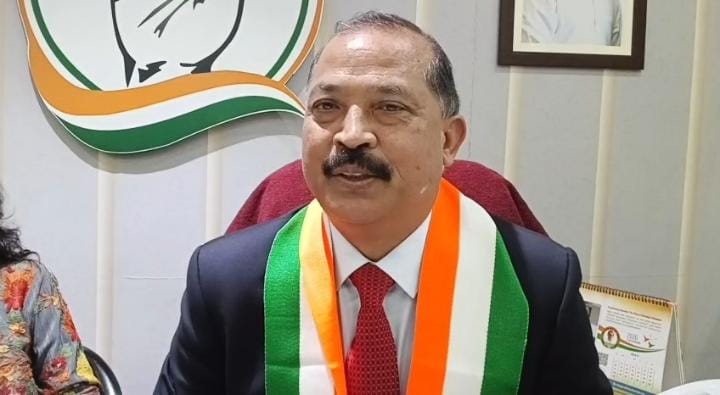
SHILLONG: The President of the Meghalaya Pradesh Congress Committee (MPCC), Vincent H. Pala, has claimed that the boundary settlement process between Assam and Meghalaya has failed.
According to Pala, the failure stems from the fact that the border talks have been confined entirely to high-level government officials, completely excluding the actual residents living in the affected areas.
This statement comes closely on the heels of a recent incident where residents of Lapangap in West Jaintia Hills District traveled to the state capital, Shillong, to express their grievances regarding ongoing harassment faced at the hands of the Karbi community.
Pala criticized the government’s initiatives and steps taken with Assam to resolve the long-standing border dispute, labeling them as mere “lip service.” He argued that these efforts would not yield fruitful results because the agreement exists only between the two governments, while the local residents remain deeply dissatisfied and do not accept the terms.
The MPCC chief further emphasized that achieving a lasting solution with Assam cannot be accomplished solely through government-to-government agreements. He stressed that any meaningful resolution must involve the Autonomous District Councils, the traditional institutions like the Hima, the Doloi, and the Rangbah Shnong (village headmen). He warned that a simplistic negotiation between Chief Ministers—arbitrarily deciding which land belongs to whom—could potentially lead to further bloodshed.
Expressing his concerns, Pala alleged that the current government is merely trying to mislead the public. He stated that if the government truly desires a flawless and permanent settlement, it must involve the local residents from all communities, even if the consultative process takes longer. He maintained that the welfare and ultimate benefit must center around those who actually reside along the interstate border.
Highlighting past instances, Pala pointed out that Assam has consistently created trouble for everyone. He expressed disappointment that despite the ongoing issues, he has not seen the government invite local dorbar shnong, village headmen, or local politicians who understand the ground realities to discuss how to properly resolve the matter.
He also took a swipe at the first phase of the border pact, alleging that the settlement was reached based on the personal land holdings of certain individuals in those areas.
He claimed that the alignment was adjusted to suit their personal interests, concluding that resolving individual problems does not equate to a proper interstate boundary settlement for the welfare of the entire state.