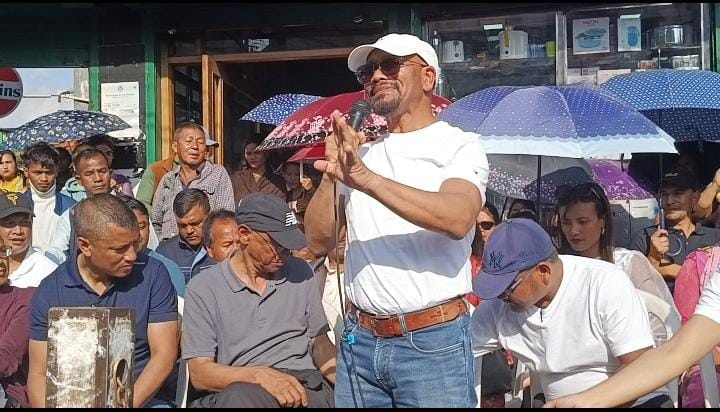
SHILLONG: In a high-decibel political intervention that has sent ripples through the state’s corridors of power, Ardent Miller Basaiawmoit, President of the Voice of the People Party (VPP) and MLA of Nongkrem, has delivered a comprehensive and stinging rebuttal to the state government.
Addressing the public with sharp clarity, the VPP leader dismantled accusations of “purely playing politics” leveled against him by the Chief Minister and Deputy Chief Minister, asserting instead that the VPP is engaged in the essential task of shaping the state’s future through principled policy and programs.
Ardent argued that it is not merely about elections or governance, but the fundamental exercise of power to craft a better life for the citizens.
He pointedly cited the Lumpongdeng controversy as a prime example of government misdirection.
While the VPP has been accused of exploiting the issue for MP election gains, Basaiawmoit countered that the party’s involvement was a moral necessity.
He highlighted that young leader H Bansiewdor Nonglang and his group had already successfully challenged the government on this front, and the VPP’s intervention was a humanitarian response to support hunger strikers who were left neglected and vulnerable by the administration.
The VPP President also spoke about the Reservation Policy, “a cornerstone of the party’s platform since 2023”.
He reminded the public that it was the VPP’s persistence that forced the creation of an Expert Committee.
However, he slammed the government’s current stalling tactics, noting that although the report was submitted in 2025, the administration is now claiming the document is “too heavy” to process quickly.
Ardent warned if the government fails to implement meaningful changes, the VPP is prepared to either take the matter to court or wait until 2028 to rewrite the policy themselves from a position of power.
Turning his focus to the government’s development model, Ardent launched a scathing critique of the plan to bring luxury hotel chains like the Taj to the state.
He argued that tourists visit Meghalaya for its pristine natural beauty, not for 5-star or 7-star concrete structures.
He voiced a deep-seated concern that such projects would marginalize locals, leaving them with menial cleaning jobs while high-level positions and even logistics—down to the transport vehicles from Assam—are handed to outsiders. He characterized the 90-year land lease for these projects as nothing short of selling out the state’s heritage.
The VPP leader further questioned the government’s “sudden” display of empathy, suggesting that the administration is only acting out of fear of the VPP’s growing influence.
He took a strong moral stand against sending local youth to work in “spa and entertainment” sectors, asserting that the Khasi community, rooted in the values of Tipb Briew Tip Blei (humanity and godliness), deserves dignified, secure employment that aligns with their cultural roots rather than jobs that lead to societal decay.
Ardent also criticized the 8-year delay in declaring Khasi and Garo as official languages of the state, a lapse he claims has weakened the case for their inclusion in the 8th Schedule of the Constitution.
He also raised eyebrows by mentioning the controversial contractor Bandri Rai, questioning how a single individual continues to bag major state projects despite a vehicle associated with him being intercepted with over ₹1.25 crore during the NPP’s election campaign in Arunachal Pradesh.
Ardent has positioned the VPP not just as an opposition party, but as a watchdog prepared to challenge the status quo on every front.