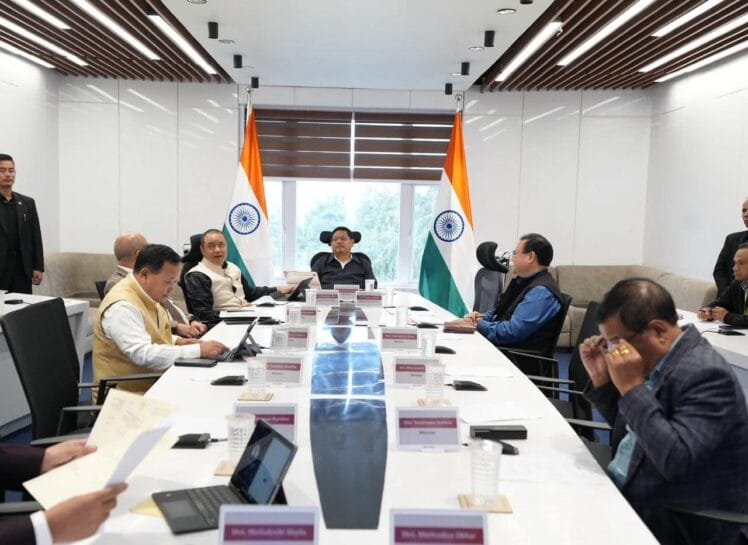
SHILLONG: The Meghalaya State Cabinet on Wednesday approved three major decisions concerning various departments, including transport and forestry, aimed at bringing administrative reforms and providing financial relief to the citizens of the state.
Briefing media persons after the meeting, Chief Minister Conrad K. Sangma announced that the government has introduced a One-Time Settlement (OTS) scheme tailored for commercial vehicle drivers and owners. This scheme will waive and reduce heavy penalties and fines accumulated under the motor vehicle tax, passengers and goods tax, and fitness fees.
The Chief Minister pointed out that a large number of trucks and commercial operators in the state have failed to renew their documents for nearly 20 years due to various reasons, including weak enforcement and negligence on the part of vehicle owners.
He clarified that while the actual tax rates fixed by the central government are relatively low, the late payment penalties accumulate to exorbitant amounts if documents are not renewed on time.
Providing an example, the Chief Minister explained that while a fitness certificate costs only around ₹1,200 annually, the late fee penalty is fixed at ₹50 per day, causing the fine to compound to nearly ₹18,000 per year.
For a commercial truck that has missed its renewals for 20 years, the accumulated penalty reaches around ₹3 lakh, a steep figure calculated under central government regulations.
According to government assessments, the total outstanding penalty for commercial vehicles in the state on fitness certificates alone has reached a staggering ₹900 crore.
Additionally, the outstanding penalty for the Motor Vehicle (MV) tax stands at ₹21 crore, and the goods and passengers tax penalty amounts to ₹5 crore.
Recognizing that nearly 100% of these truck owners and drivers belong to economically weaker sections who depend entirely on these vehicles for their livelihood, the government realized that failing to resolve this issue would cripple local transport businesses and cause acute financial distress.
Consequently, the Cabinet decided to waive 90% of the penalties accumulated on fitness certificates and 80% of the penalties on the MV tax as well as the passengers and goods tax through the OTS scheme.
This significant intervention aims to relieve local transporters from their massive tax burdens, streamline their documentation for the future, and ensure that transportation services across the state continue without interruption.
In another major decision, the Cabinet approved an administrative amendment to the Meghalaya Forest Authority Act, 1991, an legislation that has remained unchanged for nearly 35 years.
The core objective of the Authority is to facilitate seamless coordination between the State Forest Department and the Autonomous District Councils (ADCs) for the management and monitoring of forest lands.
The Chief Minister explained that the Act had previously failed to meet its objective because the Authority lacked financial powers even to host basic meetings or implement programs, a shortcoming that had drawn concern from the Law Department.
The newly approved administrative amendment will empower the Authority to utilize funds provided by the state government to oversee day-to-day operations and facilitate regular joint meetings between the Forest Department, district councils, and the state administration.
Furthermore, the Cabinet approved a notification regarding the standardized usage of name boards on government vehicles, which aligns with the state’s Standard Operating Procedure (SOP) to eliminate VIP culture, such as the unauthorized use of sirens and beacon lights.
Sangma stated that through this decision, the Transport Department has compiled a strict, definitive list specifying exactly which ranks and designations are authorized to display these name boards, moving away from arbitrary allocations based on general positions.
The Cabinet-approved list strictly restricts this privilege to top-tier government officials, members of the judiciary, the district administration, and specific statutory positions recognized by the central government.