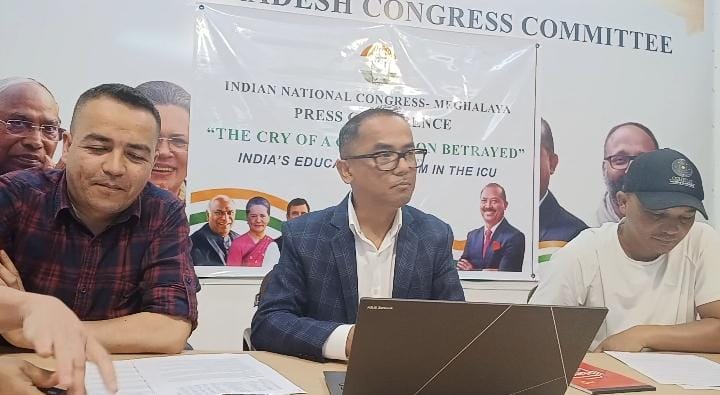
SHILLONG: The Meghalaya Pradesh Congress Committee (MPCC) has launched a scathing attack on the Central Government over the deteriorating state of education in the country, declaring that the national education system is currently in a critical condition, akin to being in the “ICU.”
Speaking at a press conference in Shillong, MPCC Social Media Cell Chairman Langkupar War presented extensive data and reports showcasing a systemic collapse characterized by compromised examinations, severe financial mismanagement, and acute hardships faced by students due to central negligence.
The Congress leader emphasized that the paper leak in the National Eligibility cum Entrance Test (NEET) is not an isolated crisis but rather a glaring symptom of a deeply corrupted national examination framework under which the government has completely lost public trust.
The crisis surrounding the NEET-UG 2026 examination, attempted by over 22 lakh students vying for medical seats with a dismal success rate of just 5 to 6 percent, has left aspirations shattered due to widespread irregularities and pre-leaked question papers.
Despite a re-examination being conducted on June 21, 2026, across 5,440 centers in 551 cities, reports from Reuters indicate that a staggering number of top-ranking students suffered severe mental exhaustion and trauma as public confidence in the entire medical entrance infrastructure crumbled.
The opposition party pinned the blame directly on the structural failure of the National Testing Agency (NTA), which had consistently promised glitch-free examinations.
This ongoing chaos mirrors the controversial NEET-UG 2024 examination, where the Supreme Court confirmed paper leaks in Patna and Hazaribagh that illegally benefited over 155 individuals.
The pattern of failure extended to the cancellation of the UGC-NET 2024, the postponement of the CUET-UG 2026, and a mandated re-test for UGC-NET 2026 in Jalandhar.
In July 2026, the Supreme Court reprimanded the NTA for failing to learn from its past mistakes, a critique underscored by the Central Bureau of Investigation (CBI) subsequently arresting several experts appointed by the NTA itself to draft examination papers.
According to Langkupar War, legislative measures introduced by the government, including the Public Examinations (Prevention of Unfair Means) Act which came into effect on June 21, 2024, have proven completely ineffective in deterring paper leaks in 2026 due to fundamentally weak institutional blueprints.
Beyond examination failures, the MPCC condemned the Central Government’s aggressive centralization of education administration in Delhi, noting that education is a concurrent subject meant to be shared between the center and states.
The opposition accused the Center of weaponizing funds to financially coerce state governments, pointing directly to the financial year 2024-25 when Samagra Shiksha funds for Kerala, Tamil Nadu, and West Bengal were abruptly withheld over disputes surrounding the PM-SHRI Memorandum of Understanding, though partial funding was later restored to Kerala and Tamil Nadu.
The situation is further compounded by severe budget cuts in public education, which are driving families into the clutches of expensive coaching centers. National expenditure on education stood at just 4.12 percent of the GDP in 2021-22, falling drastically short of the 6 percent target mandated by the National Education Policy (NEP).
In the 2024-25 budget, the Central Government slash-funded the school education department by 7 percent, higher education by 17 percent, and slashed funding to the University Grants Commission (UGC) by a massive 61 percent.
As public institutions starve for resources, families are forced to secure expensive private coaching and take massive loans to sustain their children’s education.
Concurrently, the Gross Enrolment Ratio in higher education remains stagnant at 28.4 percent against the NEP target of 50 percent by 2035, while central universities grapple with a severe faculty shortage ranging between 25 and 35 percent.
The Congress also raised alarm over the targeted elimination of minor community scholarships and curriculum modifications.
Pre-matric scholarships for minority students, including Christian students from Classes I to VIII, were discontinued from the academic year 2022-23, alongside the complete scrapping of the Maulana Azad National Fellowship and the Padho Pardesh scheme.
Simultaneously, the government removed historical chapters on the Mughal Empire and the Delhi Sultanate from the NCERT Class 7 textbooks and deleted the Periodic Table from the Class 10 Science curriculum.
At the foundational school level, the country faces a staggering deficit of educators.
A parliamentary committee warned that vacant teaching posts across the nation are nearing 10 lakh, with 8,46,647 vacant positions recorded in 2023-24 alone, leading to overcrowded classrooms and multi-grade teaching under single instructors.
Consequently, the ASER 2024 report revealed that only 23.4 percent of Class 3 students in government schools can read a basic Class 2 textbook. Although the national dropout rate showed a marginal decline from 10.9 percent to 8.2 percent, the reality remains grim with 1,04,125 schools operating with just a single teacher and 7,993 schools recording zero student enrollment.
This rote-learning system has triggered a massive youth unemployment crisis, leaving students trapped in a cycle of anxiety extending from the examination hall to the job market.
For Meghalaya, this national administrative failure translates into an immediate, heavy burden.
A total of 4,164 students from the state were forced to appear for the NEET re-examination across 14 state centers, which included 10 centers in Shillong, 2 in Tura, 1 in Jowai, and 1 at NEPA/Umiam.
Because Meghalaya heavily relies on a 90:10 funding pattern for the central Samagra Shiksha scheme, any central budget cuts instantly hit the state’s primary education system first.
Furthermore, the Central Government’s plan to transition NEET completely to a computer-based test by 2027 threatens to severely disadvantage rural and tribal students from hilly terrains due to acute digital deficits.
Nationally, 64.7 percent of schools have computers and 63.5 percent have internet access, but Meghalaya ranks at the absolute bottom in India with a mere 19.7 percent of its schools equipped with computers.
Compounded by difficult hilly topography and a lack of localized coaching infrastructure, the necessity of repeated travels and re-examinations places a crushing financial strain on tribal households across the Khasi, Jaintia, and Garo Hills.
In response to this multi-level crisis, the Congress party has placed a series of formal demands and sharp questions before the Central Government.
The MPCC demands the immediate resignation of the Union Education Minister over the monumental failure to conduct clean national assessments. The party calls for a time-bound, independent judicial probe into the NTA and NEET irregularities spanning from 2024 to 2026, alongside the publication of a comprehensive White Paper detailing all examination cancellations and paper leaks since 2018.
The Congress said, the Central Government must clarify which recommendations of the Radhakrishnan Committee out of the 101 proposals were actually implemented prior to the 2026 exams, and must completely restructure the testing apparatus with a transparent, fully staffed agency.
Additional demands include the immediate filling of the 8.46 lakh vacant teaching positions, raising the education budget to 6 percent of the GDP, protecting university autonomy, providing psychological and financial compensation to affected students, and convening a dedicated parliamentary debate on the future of national testing.
The MPCC concluded by demanding answers as to how the NEET papers could leak yet again in 2026 despite specific Supreme Court directives issued in 2024, and challenged the government to reveal the identities of the NTA-appointed experts arrested by the CBI.
The party questioned the rationale behind enforcing mandatory computer-based testing by 2027 when thousands of schools lack even a single functional computer, and asked whether the Center plans to provide special financial relief to the students of the Northeast and tribal hill areas who have been forced to repeatedly self-fund their travels for re-examinations.
The MPCC stated that all figures presented in their brief are meticulously sourced from verified public records, including the Supreme Court, Digital Sansad parliamentary replies, UDISE Plus 2024-25, AISHE 2021-22, ASER 2024, official NTA notices, and reputable national news agencies.