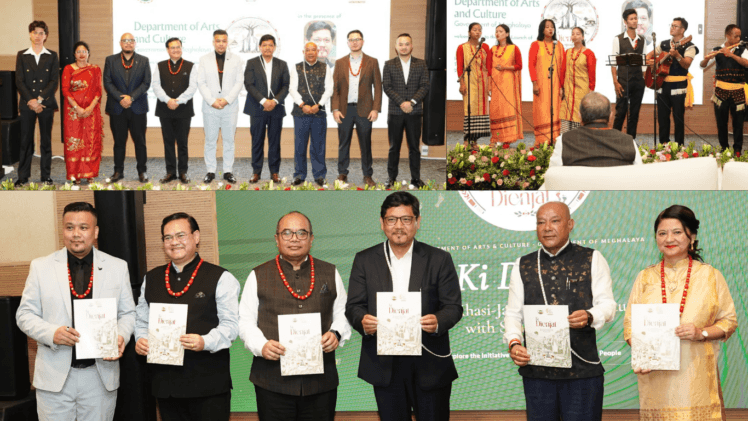
SHILLONG: In a historic step to uncover the ancient lineage of Meghalaya’s indigenous communities, Chief Minister Conrad K. Sangma has launched ‘Ki Dienjat’—a pioneering state-backed research initiative dedicated to tracing the socio-cultural and migratory ties of the Khasi-Jaintia tribes across Southeast Asia.
The launch event was attended by Arts and Culture Minister Sanbor Shullai, Justice Hamarsan Singh Thangkhiew, the Principal Secretary of Arts and Culture, research delegates, and senior officials.
Chief Minister Sangma described the project as a journey of profound rediscovery, stressing that understanding ancestral history is crucial for shaping identity and the future. While oral traditions and colonial records have long suggested that the Khasi and Jaintia peoples originated from regions now known as Cambodia and Laos, contemporary academic validation has been hampered by limited resources, logistical barriers, and lack of cross-border collaboration.
To address these challenges, the government has established a specialized interdisciplinary study group under the Department of Arts and Culture to systematically explore ancestral migration routes.
To streamline research efforts, the Chief Minister also unveiled the official Ki Dienjat e-Portal—a centralized digital platform designed to manage research data, facilitate collaboration, and enhance transparency.
ALSO READ: Rhythm of the Fields: How Mawtari-Thaiang Revives Indigenous Farming Traditions
The portal will modernize workflow, reduce administrative costs, and serve as a dynamic hub for scholars, institutions, and indigenous communities to share knowledge and foster heritage preservation.
Sangma credited the late P. A. Sangma with inspiring the project, noting his vision for rigorous research into tribal origins.
In tribute, a parallel research initiative for the Garo Hills region will be launched on September 1, 2026, marking the birth anniversary of the former Lok Sabha Speaker.
The umbrella ‘Tracing the Roots’ initiative brings together oral history, indigenous wisdom, linguistics, archaeology, and scientific methods.
A multidisciplinary team of 75 scholars will conduct fieldwork across Vietnam, Cambodia, and Tibet, aiming to document the historic migration paths of the Khasi, Jaintia, and Garo peoples. The findings will be compiled into digital archives, scholarly publications, and educational resources.
Acknowledging the sensitivities involved in deep historical research, Chief Minister Sangma called for the inclusion of young researchers and active participation from local communities, as well as support from national and international partners.
To mark the project’s commencement, he released the official project document and inaugurated the new Ki Dienjat Research Room at the Williamson Sangma State Museum in Shillong.
(4FrontMedia news)