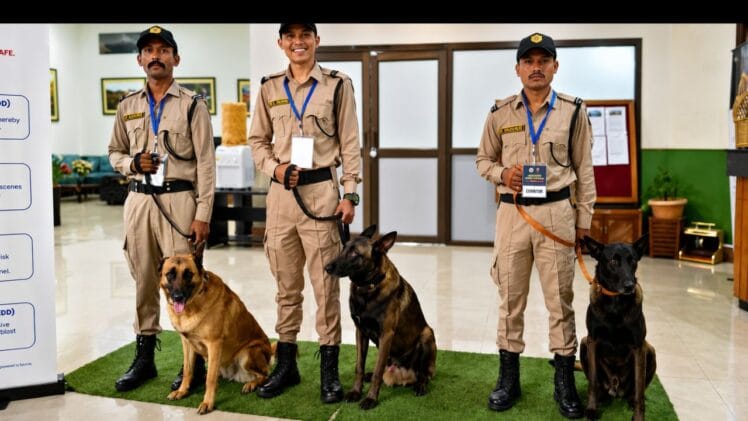
SHILLONG: From just two dogs in the mid-1970s to a highly trained force of 37 K9s today, the Meghalaya Police K9 Unit has evolved into one of the state’s most vital assets in law enforcement. Established under the CID in Shillong around 1974–75, the unit has steadily expanded in both size and capability, keeping pace with modern policing challenges.
Today, the unit comprises 32 Belgian Malinois and 5 Cocker Spaniels, all imported breeds known for their intelligence, agility, and strong scent-detection abilities. These four-legged officers are not just trained companions—they are specialists deployed across seven locations in Meghalaya, playing a crucial role in maintaining law and order.
Meet & Greet with Meghalaya Police’s Four-Legged Stars
It wasn’t just another day at the exhibition—it was a star-studded appearance of Meghalaya Police’s most loyal heroes.
Shadow, Elsa, and Peter—three of the finest from the K9 Unit—captured attention and hearts alike as they made a special appearance at the Nyaya Sanhita Exhibition held at the State Convention Centre. Organised by the Home (Police) Department, Government of Meghalaya, the event turned into a memorable meet-and-greet with the state’s real-life canine protectors.
Visitors got a rare chance to see and pat these highly trained K9s up close—the same dogs that are usually on the frontlines, sniffing out narcotics, detecting explosives, and assisting in critical operations across the state. Calm, alert, and incredibly disciplined, Shadow, Elsa, and Peter showcased not just their training—but also their unique personalities.
For many, it was a moment of admiration. For the K9s, just another day of duty—serving with loyalty, courage, and a wagging tail.
Specialized Roles, Critical Missions
According to one of the handlers present at the exhibition today, each K9 is trained for a specific discipline. The current distribution reflects the unit’s operational priorities:
- 14 Narcotics Detection Dogs
- 11 Explosive Detection Dogs
- 10 Tracker Dogs
- 2 Assault Dogs (non-lethal anti-terror roles)
Whether it is sniffing out hidden drugs, detecting explosives, tracking suspects, or supporting anti-terror operations, these dogs operate with remarkable precision. Their contribution has been instrumental in major drug seizures, including heroin hauls worth crores in Ri-Bhoi, and in preventing potential threats through timely detection.
Training, Discipline, and Lifelong Bonds
Becoming a K9 officer is no small feat. Each dog undergoes seven months of intensive basic training, followed by daily drills and continuous skill enhancement. Training includes agility, obedience, scent detection, and tactical response.
Handlers, carefully selected from different police units, are trained alongside the dogs—often at specialized centres such as those in Bengaluru. The relationship between handler and K9 is built on trust, consistency, and constant interaction, forming a lifelong bond that is critical for operational success.
A Dedicated Facility in Shillong
The K9 Unit operates from a specialized facility in Pynthorumkhrah, Shillong, where the dogs are housed, trained, and cared for. The environment is designed to ensure both their physical fitness and mental sharpness, enabling them to perform under high-pressure situations.
Honouring Service Beyond Duty
In Meghalaya Police, K9s are treated as full-fledged members of the force. From active service to retirement, they are accorded dignity and respect. When a K9 passes away, it is given full honours, recognizing its contribution to public safety.
Among the many dogs in service, names like Shadow, Elsa, and Peter have become familiar faces—symbols of dedication and courage.
Recognised for Excellence
The unit’s consistent success has earned recognition at the highest levels. Leaders like Chief Minister Conrad Sangma and Deputy Chief Minister (Home) Prestone Tynsong have frequently honoured K9s and their handlers with medals for exceptional service.
A Force That Continues to Grow
As Meghalaya faces evolving security challenges, the K9 Unit remains at the forefront—quietly working, often unseen, but always essential. With their sharp instincts, rigorous training, and unwavering loyalty, these dogs continue to prove that some of the bravest officers don’t carry weapons—they carry a nose for justice.