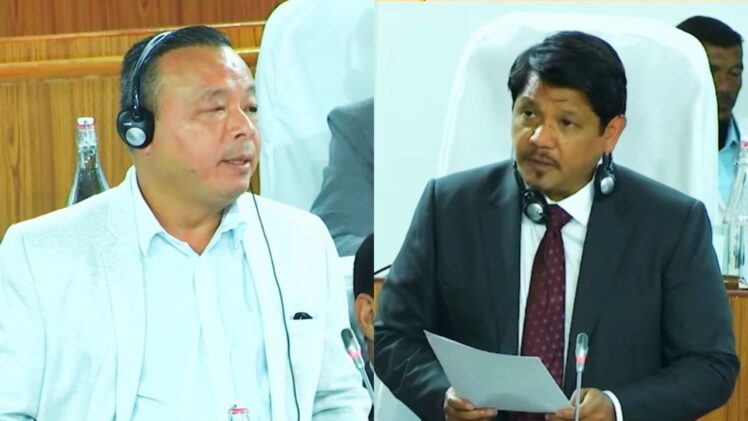
SHILLONG: West Shillong MLA Paul Lyngdoh, on Wednesday, raised a Short Duration Discussion under Rule 50 of the Rules of Procedure and Conduct of Business, proposing that the Shillong Urban Agglomeration be carved out of East Khasi Hills district and constituted into a full-fledged district to ensure administrative convenience and stronger governance.
The proposal received support from Charles Pyngrope, MLA of Nongthymmai, and A. L. Hek, MLA of Pynthorumkhrah.
Replying to the discussion, Chief Minister Conrad Sangma appreciated Lyngdoh for raising an issue of urgent public importance. He stated that the proposal to create a separate district from the Shillong Urban Agglomeration was significant and warranted careful examination.
The Chief Minister said the matter relates to key principles of administrative convenience, efficient governance, and responsive public service delivery, especially as the State capital continues to grow in size, complexity, and population. He noted that it was timely for the House to deliberate on the issue in the larger interest of effective administration.
Explaining the concept of Urban Agglomeration as per the Census of India 2011, Sangma said it refers to a continuous urban spread comprising a statutory town and its adjoining outgrowths, or two or more physically connected towns, with a minimum population of 20,000. Such agglomerations function as integrated urban clusters.
He informed that the Shillong Planning Area spans about 290.51 square kilometres and includes the Shillong Municipal Board, Shillong Cantonment Board, and 10 census towns such as Mawlai, Nongthymmai, Madanrting, Umpling, Mawpat, and Lawsohtun, along with 54 villages across East Khasi Hills and Ri-Bhoi districts.
According to Census 2011 data, the Shillong Planning Area had a total population of 4,22,372, of which 3,54,759 were part of the urban agglomeration. The population is projected to cross 4.47 lakh by 2041, reflecting rapid urban expansion.
Sangma pointed out that Shillong has a unique administrative structure involving multiple agencies, including the Municipal Board, Khasi Hills Autonomous District Council, traditional institutions, and various government departments. He stressed the need for coordinated planning and integrated governance to address emerging urban challenges.
He further observed that unprecedented urban growth has placed immense pressure on civic administration, infrastructure, and public services.
The Chief Minister explained that the creation of a new district or sub-division depends on several factors, including geographical area, population, distance from existing headquarters, availability of essential services, public convenience, communication facilities, and financial viability. Such proposals are examined by a high-level committee headed by the Chief Secretary and comprising senior government officials.
Assuring the House, Sangma said the government would thoroughly scrutinise the proposal before arriving at an informed decision in the interest of better governance and citizen-centric administration.
He concluded by appreciating Lyngdoh for initiating the discussion, stating that it had opened the door for constructive deliberation on strengthening governance and administrative efficiency in the State capital.