By Lyzander E Sohkhlet & Ardamanki Pariat
“The world is meant to be a gallery of individuality, where every person adds their own colour, texture and story.”
I found myself thinking about those words while standing amongst hundreds of strangers.
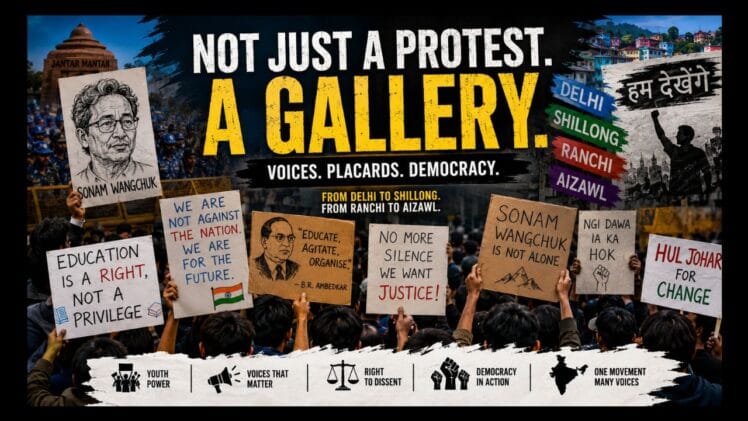
It is easy to mistake a protest for a crowd. It is much harder to notice the people within it. Beyond the chants and speeches were hundreds of handmade placards, each one carrying its own humour, grief, anger or hope. Some quoted Ambedkar. Some sketched Sonam Wangchuk. Some simply asked for justice. Together, they transformed ordinary streets into something extraordinary, not merely a protest, but a living gallery of India’s youth. Walk into any protest, whether in Delhi, Shillong or Ranchi, and before you hear the slogans, before you see the crowds, your eyes almost always wander to the placards. Hundreds of them. No two alike. Some are carefully painted the night before, their colours still drying as they are carried through the streets. Others are nothing more than black marker on the back of an old Amazon box. Some make you laugh. Some make you uncomfortable. Some simply leave you standing there for a moment longer than you expected.
I realised then that protests are perhaps the closest thing democracy has to an art gallery.
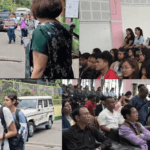
Over the past week, Arda and I spoke with protesters who travelled to Delhi’s Jantar Mantar and with others who organised solidarity demonstrations in Shillong and Ranchi. Their politics were not identical. Their backgrounds differed. Their languages shifted from Hindi to Khasi to English. Yet one feeling appeared again and again. They believed they could no longer remain spectators.
That belief met its greatest test on the twenty-first day of Sonam Wangchuk’s hunger strike.
Blue-clad, nametag-less armed personnel stood shoulder to shoulder around the crowd as cries of resistance echoed through Jantar Mantar. This was the sight painted on the 21st day, they recalled watching Sonam Wangchuk being taken away under police escort and witnessing what they perceived as a heavy-handed response to a gathering they insist had remained peaceful. For many, what began as outrage over alleged failures in the education system evolved into a broader conversation about dissent, accountability and the right to protest. Behind the gilded vision of India and behind the white sheets that covered this site lie a commonality- a democracy straining under the weight of its own contradictions.
The deaths of students which protesters attributed to the education system following the leak of the NEET paper torched the fire but what really sparked the change was the participation of the Cockroach Janta Party (CJP)- giving a platform for the educated youth, and the renowned activist Sonam Wangchuk. One respondent drew a striking comparison to the Jallianwala Bagh incident, where the protester drew a parallel between the brutality he witnessed then and the brutality he was witnessing now. Hundreds of students at Jantar Mantar witnessed the heavy-handed police response where many suffered. The chants of ‘Inqilab zindabad’ slowly began to fade as police began practicing brutal “mob control” measures, laathi charging the youth of our country. What once lay to be a peaceful protest soon became a scene of chaos- students beaten back by the very force meant to protect them. These are deeply contested accounts, but they formed a recurring thread across many of the testimonies we gathered.
However, the Delhi Police posted a notice that read “Some segments from media have mentioned sporadic use of violence/detention by the Delhi Police.” and denies that such an incident ever took place despite the presence of photos and videos and, accounts by victims as evidence for the violence. For many of the protesters we interviewed, however, the official denial only deepened their sense that their experiences were not being acknowledged.
In the midst of this, what remains clear is the enthralling power of a youth in transforming a society. But what if that youth remains shut down? What if that youth faces obstruction from participating in a revolution? What happens if your very own parents are against the protest? One interviewee spoke of those who stayed home because their parents feared for their safety or disagreed with the movement altogether. Others described being labelled anti-national or accused of advancing hidden political agendas simply for participating. For many students, the struggle was not only against institutions but also within their own homes, where dinner-table conversations became as contentious as the streets outside. She recalls not being allowed to participate in the protests due to ideological differences. She says that these differences are infused upon the minds of parents and elders through the media, accusing the protest to be anti-national, to be foreign funded, to be violent, when all it was and has been is peaceful. What happens if critics paint the one person standing up for your children’s education as a foreign spy? You are left asking what kind of nation letsthat accusation stand unquestioned, she says.
As when despair creeps in, hope channels through. The Delhi High Court took up petitions concerning the events at Jantar Mantar. The court directed the preservation of CCTV footage and other digital evidence and sought responses from the Centre and Delhi Police on petitions alleging excessive use of force. On another occassion, the legal services organisation Software Freedom Law Center (SFLC), India, filed a PIL challenging the Ministry of Home Affairs’ orders to suspend mobile internet services within a 1.5-kilometre radius of Jantar Mantar. The Court scheduled an urgent hearing on this matter. Even amid the turmoil, the legal process continued to provide a forum for scrutiny and accountability.
Beyond Delhi, the movement began speaking in different languages.
The slogans of “Jai Hind”, “Vande Mataram” travelled Eastward to Shillong with slogans like “Ngi dawa ia ka hok” in Khasi. In Ranchi, solidarity found expression through “Sonam Wangchuk ko Hul Johar,” drawing from Jharkhand’s own revolutionary traditions, linking the movement with the legacy of the Santhal Hul and the memory of leaders such as Sidhu and Kanhu. Every city translated the movement into its own vocabulary without losing sight of its common purpose.. . The experiences of protesters outside Delhi also differed markedly. In Jorhat, Assam, students remembered police officers passing around bottles of water beneath the unforgiving summer heat. Participants in Shillong and Ranchi consistently described local police as maintaining order while allowing demonstrations to proceed peacefully.
One protester recalled an unexpected conversation on the metro ride home. Police personnel who stopped him because he was carrying the national flag asked where he had come from. When he told them he had been at Jantar Mantar, they listened as he described what he had witnessed. According to the protester, some officers quietly acknowledged the movement’s demands, saying that if so many people had gathered around a single issue, there must be a reason. They also remarked that while they were duty-bound to follow orders, they hoped the government would listen to the students.
The chants that erupted in Jantar Mantar did not end in Delhi. They found new voices in Shillong, Ranchi, Aizawl and elsewhere capturing localised versions of the protest, translated in different languages. Even if one agrees with the movement or not, its greatest achievement may have been reminding a generation that democracy is sustained not by silence, but by participation.
But by the time the echoes of Jantar Mantar reached Aizawl, they no longer belonged to Delhi alone. They belonged to students who had never set foot in the capital, yet felt every slogan as though it had been shouted from their own streets. Outside Vanapa Hall, “Jai Hind” gave way to Mizo voices. If Delhi had become the movement’s heartbeat, Aizawl became another pulse.
Then, almost unexpectedly, the slogans faded.
Someone began humming Give Me Some Sunshine.
Within seconds, hundreds of voices joined in. For most Indians, it is just another song from 3 Idiots. For the students gathered in Aizawl, it carried a different memory. The film had introduced an entire generation to the ideas of Sonam Wangchuk long before many knew his real name. They had laughed with Rancho, questioned the education system alongside him, and unknowingly grown up with a story inspired by the very man they had now come to support. Standing there, it felt strangely circular, said a student
A fictional classroom had once taught us to question an education system that measured marks before minds. Years later, those same students had stepped out of their classrooms, singing the same song. For a moment, it didn’t feel like a protest. It felt like a generation remembering why it cared in the first place.
Looking back, what remains with us is not merely the barricades or the headlines.
It is the cardboard.
The carefully painted slogans.
The jokes that made strangers laugh.
The portraits of Ambedkar, Gandhi and Sonam Wangchuk.
The Khasi words in Shillong.
The Hul Johar greetings in Ranchi.
Every placard was different because every protester was different.
Perhaps that is the greatest misconception about protests. History remembers crowds. It remembers numbers, clashes and speeches. It rarely remembers the individual standing quietly in the middle of it all, holding a piece of cardboard that tells the story only they could have written.
Whether one agrees with the movement or not, its greatest achievement may have been reminding a generation that democracy is sustained not by silence, but by participation.
And perhaps that is what a protest really is.
Not merely a gathering.
But a gallery.
(Lyzander E Sohkhlet is a student of St. Edmund’s College, Shillong, BA Political Science & Ardamanki Pariat is a student of St. Stephen’s College, Delhi, BA History Hons)
The opinions expressed in this publication are those of the author. They do not purport to reflect the opinions or views of 4Front Media or its members.