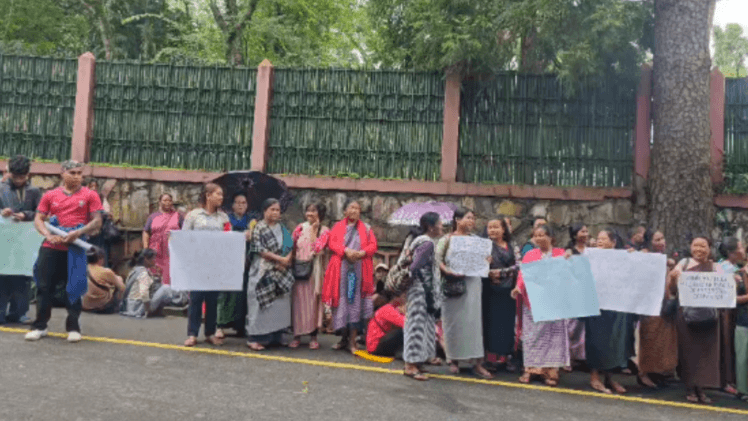
SHILLONG: In a dramatic escalation of tensions over alleged administrative overreach, hundreds of street vendors under the Greater Shillong Progressive Hawkers and Street Vendors Association (MGSPHSVA) marched to the Shillong Municipal Board (SMB) office, staging a massive protest against what they call arbitrary and illegal actions by the authorities.
The demonstration, organized by MGSPHSVA, was aimed at demanding the immediate formation of a permanent, lawfully constituted Town Vending Committee (TVC) through a fair and democratic election. The association strongly condemned what it described as ongoing violations of statutory laws designed to protect the rights of street vendors across Meghalaya.
Addressing the media during the protest, MGSPHSVA General Secretary S. Thabah explained that vendors had been left with no choice but to take to the streets, as their situation had become intolerable. Thabah highlighted that the current body overseeing vendor affairs is only a Provisional Town Vending Committee (PTVC), which, by law, was meant to exist for no longer than one year.
Instead of dissolving the PTVC and holding elections, the government has illegally extended its tenure and granted it sweeping authority to make decisions that deeply affect vendors’ livelihoods. This move, Thabah argued, is a clear violation of statutory provisions.
ALSO READ: Laitumkhrah Set for Major Facelift as Ampareen Lyngdoh Promises End to Traffic Chaos
The association further emphasized that critical decisions impacting thousands of vulnerable citizens are being taken without collective input or consensus. Thabah accused the PTVC of acting as a mere puppet, undermining democratic norms to serve the interests of a single powerful individual.
This erosion of institutional integrity has fueled widespread discontent, drawing vendors from key commercial centers such as Iewduh and Motphran into the protest. The MGSPHSVA reminded authorities that these are historic “Heritage Markets,” protected by specific legal provisions that prohibit arbitrary eviction or displacement of traditional vendors without proper alternatives.
The association also questioned the logic behind recent government policies, particularly the issuance of Certificates of Vending (COV) without actually providing vendors with physical spaces to operate. Thabah asked where the government expects vendors to go once they are removed from the streets.
To underscore these systemic failures, the association cited the case of Laitumkhrah, where vendors, local leaders, and government representatives had jointly identified and approved vending zones.
Despite the zones being less than ideal, vendors cooperated for the sake of public order. However, the government later reneged on its agreement, revoked the approved zones, and declared them non-vending areas—leaving the working poor in despair.
The MGSPHSVA also criticized the relocation process at the Meghalaya Transport Corporation (MTC) site, pointing out that different markets cater to distinct public needs in Laitumkhrah, GS Road, and Iewduh. Initially, it was agreed that vendors would be relocated according to their trade specialties, with care taken not to mix different trades indiscriminately.
Despite this, the government bypassed the committee and unilaterally relocated cloth vendors to Polo, a move the association called discriminatory and a blatant disregard for established procedures.
In light of these grievances, the MGSPHSVA has demanded that the government immediately conduct transparent elections to form a permanent Town Vending Committee, ensuring equity, justice, and effective urban governance.
(4FrontMedia news)