SHILLONG: The Jaiñtia National Council (JNC) on Tuesday submitted a representation to the fact-finding committee constituted by the State Government in connection with the proposed Shree Cement project at Lum Syrman in East Jaintia Hills district.
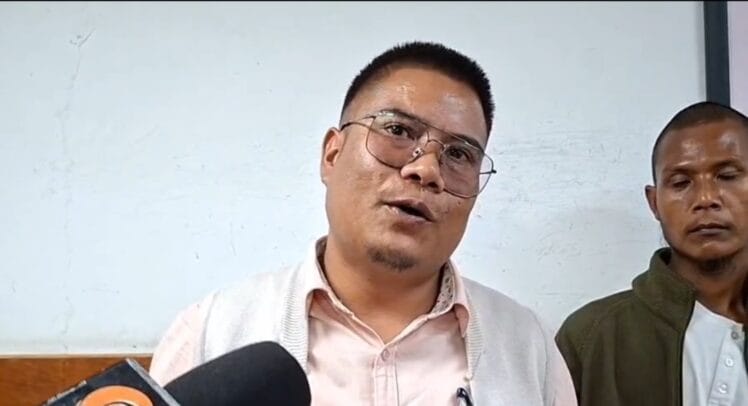
Speaking to reporters after submitting the representation, JNC president Sambormi Lyngdoh said the organisation had raised concerns over the conduct of the public hearing for the project. He alleged that the public hearing conducted by Shree Cement was held with the assistance of the government and police, and claimed that those opposed to the project were not given an opportunity to participate.
He said this was against the procedure of a public hearing, which, according to him, should provide an opportunity to both supporters and opponents of a project to present their views.
Lyngdoh said the JNC had submitted its representation to the committee on three key issues, including events surrounding the public hearing held on July 30 and 31 and questions relating to land ownership.
He said the leadership of Elaka Nongkhlieh had stated that the land concerned had not been sold to the company but had been leased to it. However, according to Lyngdoh, the JNC found that the Environmental Impact Assessment (EIA) report of Shree Cement claimed ownership of the land and stated that the company had purchased it for an amount exceeding Rs 5 crore.
He further claimed that a document from the Mining and Geology Department also showed the company claiming ownership of the land.
ALSO READ: The Land Belongs to the People of East Jaintia Hills — Or to Shree Cement: Whose Land Is It, Really?
Lyngdoh questioned how the company could claim ownership of the land, stating that Meghalaya is a Sixth Schedule area and that land transactions involving tribal and non-tribal parties are subject to specific legal provisions. He alleged that the required procedures had not been followed in this case.
The JNC president also raised questions over the difference in the area mentioned in various applications submitted by the company.
According to Lyngdoh, while the proposed mining project covers 217 hectares, the company had applied to the Jaintia Hills Autonomous District Council (JHADC) for an NOC covering 652 hectares. He further claimed that the company had also obtained approval for a non-forest land certificate covering 652 hectares from the Forest Department, while its mining application covered only 217 hectares.
He questioned why the company sought approvals for 652 hectares if the proposed mining activity was limited to 217 hectares.
Lyngdoh further claimed that the JNC had found that the company had divided the larger area into three blocks of approximately 217 hectares each. He alleged that this was an attempt by the company, with the support of the State Government, to avoid provisions of central law applicable to larger mining areas.
The JNC said it had submitted the relevant documents to the fact-finding committee and would await its findings and the response of the State Government.
Lyngdoh, however, said the JNC had limited expectations from the fact-finding process, alleging that the exercise could delay the matter. He said the organisation was nevertheless submitting its representation as part of the due process and to establish that all available administrative avenues had been exhausted before considering legal action.
On the government’s contention that many of those opposing the project were outsiders, Lyngdoh said residents of areas including Chnongrim, Daistong and Elaka Sutnga had also submitted objections or representations before the fact-finding committee.
He said the JNC, being headquartered in East Jaintia Hills, considered itself directly connected to the issue and questioned the description of project opponents as outsiders.
Lyngdoh also questioned who should be regarded as an outsider in the context of the proposed project, pointing to the company’s ownership and the local residents who may be affected by the proposed development.