SHILLONG: A protest is, at its core, an expression of public frustration. It is a means through which citizens can question those in power, demand accountability and force governments to confront issues they may otherwise choose to ignore.
But when a protest that claims to speak for the people begins to cause fear among the very people it seeks to represent, an uncomfortable question must be asked: who, ultimately, is the protest serving?
The Black Flag Rally organised by the Khasi Students’ Union (KSU) on Wednesday was intended to send a strong message to the Meghalaya Government over what the union described as inaction on several pending demands. Such demands deserve to be debated. Governments must be held accountable, and peaceful democratic protest is an essential part of that process.
Yet the reported incidents surrounding Wednesday’s rally have overshadowed that message.
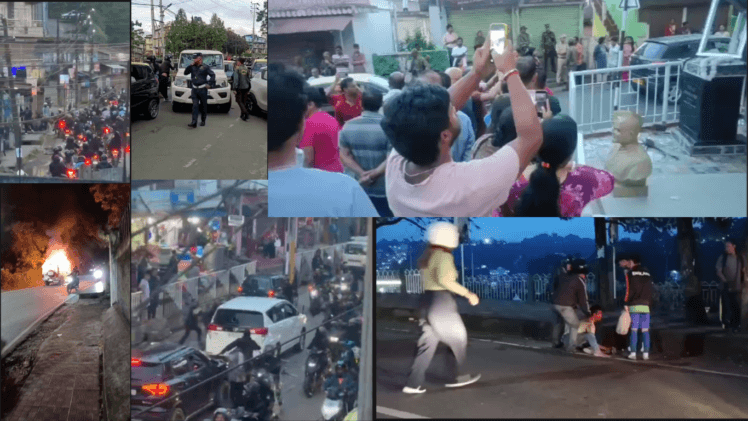
Reports of vehicles being damaged in several parts of Shillong, particularly in areas such as RR Colony and Nongmynsong, residents allegedly being assaulted, and government property being targeted paint a disturbing picture.
At Mawlai Nongmali, a government Bolero was allegedly set on fire, while an FCI truck was reportedly damaged by masked individuals travelling on two-wheelers.
If these allegations are established, they cannot simply be dismissed as an unfortunate side effect of protest.
There is a fundamental difference between confronting a government and intimidating ordinary citizens.
The anger directed at the government should not become anger directed at motorists, residents, workers or public property.
A vehicle bearing an Assam registration number does not, by itself, represent a political position. A government employee travelling in an official vehicle is not necessarily responsible for the decisions of the government.
And an ordinary resident going about their daily life should never have to fear being caught in the middle of a political confrontation.
This is where the larger concern lies.
Meghalaya has a long history of student and civil society movements that have played an important role in shaping public discourse. The strength of such movements has traditionally come from their ability to mobilise people and articulate issues that matter to society.
That moral authority becomes weaker when masked individuals allegedly resort to violence and destruction.
There is also a serious question of leadership and accountability. If an organisation calls people onto the streets under its banner, it must also be prepared to ensure that the protest remains within the boundaries of law and democratic conduct.
Those who commit violence cannot be allowed to hide behind the larger cause of a movement.
At the same time, accountability cannot be selective. If violence occurred, the authorities must investigate it impartially.
Those responsible should be identified and dealt with according to law, regardless of their affiliation.
Equally, the government must not use incidents of violence as an excuse to dismiss legitimate grievances raised by the protesters.
The demands that brought people onto the streets still deserve answers.
But a movement loses something important when the demand for justice begins to produce fear.
The government has a responsibility to listen. Protest leaders have a responsibility to lead responsibly. And citizens have a right to disagree without becoming targets.
A black flag can be a powerful symbol of dissent. It should never become a symbol of intimidation.
If the purpose of a movement is genuinely to fight for the people, then the people must remain at the centre of that fight—not become its collateral damage.
The incidents reported on Wednesday, therefore, deserve more than political statements and competing accusations.
They deserve a transparent investigation, accountability for anyone found responsible, and a serious conversation about the kind of democratic protest Meghalaya wants to uphold.
Because in the end, the credibility of any movement is measured not only by the strength of its demands, but by the manner in which it fights for them.
ALSO READ: KSU Issues 15-Day Ultimatum to Govt Over Shree Cement Row