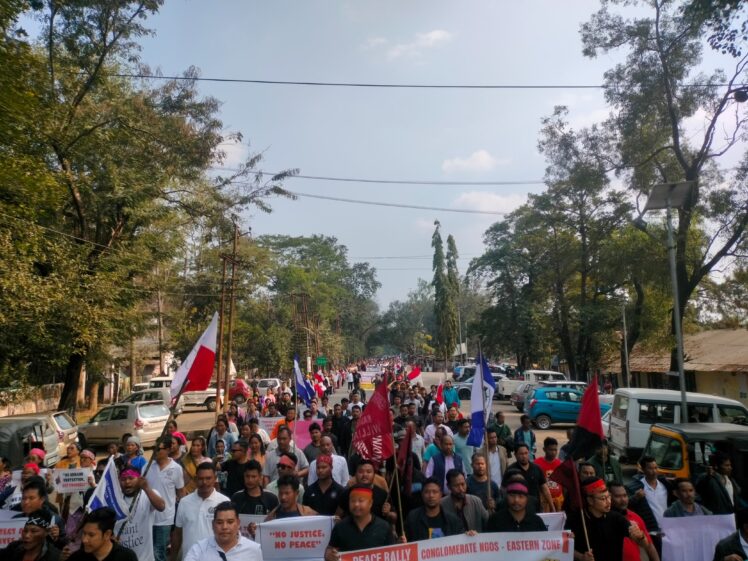
WILLIAMNAGAR: Williamnagar came to a complete standstill on Monday as thousands of people poured onto the streets in a massive and peaceful protest, demanding immediate justice in a case that has deeply shaken the Garo Hills region.
In a display of unity and public resolve, commercial activity across the town came to a halt, with shops and business establishments remaining closed in what was described as a voluntary shutdown. The march reflected not just public anger, but a collective call for accountability and timely justice for the murder of activist Dilseng M. Sangma.
The peace march was led by the Garo Students’ Union (Eastern Zone) and witnessed the coming together of more than 15 civil society organisations, marking one of the largest coordinated protests in recent times in East Garo Hills.
Prominent organisations that took part included FKJGP, AHAM, ACHIK, AIGU, the Simsanggre Indigenous People’s Forum (SIPF), along with the Mother’s Union, AOSW, and local Pick-Up and Auto Associations. Advocacy groups such as NGCO, ADIL, AAYF, and FAF also joined the demonstration, lending strength to the collective demand.
A public meeting was held at Rongrenggre Government Higher Secondary School, chaired by Taison D. Sangma of the All India Garo Union. During the meeting, student leaders, community representatives, and concerned parents addressed the gathering, underscoring that the incident in question had shaken the conscience of the region.
Speakers stressed that justice must not be delayed and warned that public patience was wearing thin. The repeated message from the stage was clear: the people of Garo Hills are united and resolute in their demand for accountability.
Following the meeting, a massive procession marched peacefully through key areas of Williamnagar, including Soil Lake, the Main Market, and the Deputy Commissioner’s Office. The route symbolically underscored the community’s appeal for decisive administrative action.
Men, women, students, and elders marched side by side, chanting slogans calling for justice, fairness, and transparency.
By bringing together students, mothers, workers, and civil society groups, Williamnagar made it clear that the issue has transcended local boundaries and evolved into a broader movement for justice and systemic accountability in the Garo Hills.