MAWLYNNONG:
During late spring this year, I visited Mawlynnong village for my fieldwork, with the sole purpose of studying the environmental aspects of this world-famous clean village, which was given the title of “Asia’s Cleanest Village” in 2003. When I interacted with the village members, I discovered something far more interesting. While the media often highlights its cleanliness, something much deeper stayed with me long after I completed my dissertation.
The history of Mawlynnong’s cleanliness began approximately 130 years ago due to a severe cholera epidemic. During this crisis, Christian missionaries reportedly advised the Khasi ancestors on the vital role of hygiene and cleanliness in preventing contagion. What started as a pragmatic survival measure gradually evolved into a deeply ingrained communal ethos through consistent practice and intergenerational teaching.
The Church of Epiphany, built in 1902 by Welsh Christian missionaries, is central to this tradition. Residents explicitly told me that these missionaries changed their lives. This narrative highlights the powerful integration of spiritual devotion with practical hygiene, reinforcing the adage that “Cleanliness is next to Godliness,” thereby elevating hygiene to a moral and spiritual virtue. The teachings of the missionaries provided a framework that integrated these hygiene measures into the community’s belief system. This dual reinforcement, appealing to both health and spiritual values, created a highly resilient and deeply internalised commitment to cleanliness. The village’s transformation and global recognition were also significantly aided by the construction of a road to Mawlynnong.
The village’s name stems from two Khasi words: maw, meaning rock or stone, and lynnong, referring to something hollow-like. The village was historically known for its abundance of hollowed-out rocks, which were used to ferment Kwai (betel nut). Beyond its renowned cleanliness, Mawlynnong exemplifies environmental consciousness through its simple yet eco-friendly aesthetics and infrastructure.
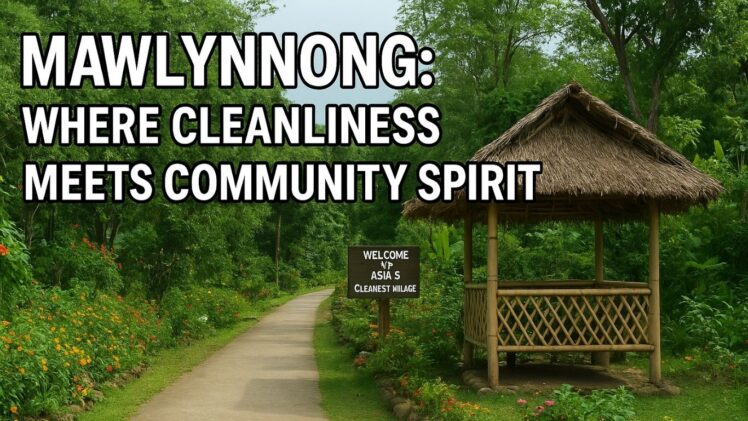
The community builds small, open resting huts from local bamboo, providing shelter for pedestrians and showcasing their sustainable building practices. Public benches are also fashioned from natural materials like bamboo or betel nut wood. The residents are avid floriculturists, a passion evident in virtually every household. Every home is adorned with flowers and foliage, which enhances the village’s aesthetic appeal and contributes to the conservation of local flora.
According to the village headman, this affinity for floriculture is an ancestral tradition. Following Mawlynnong’s global recognition, the village council has extended this beautification effort to public spaces. Water-worn stones from nearby streams are strategically placed along the edges of pathways to maintain neatness. For cleaning, villagers consistently use traditional, eco-friendly tools, including the synsar (a broomstick), the synsar motor (a bamboo broomstick), and the khoh (a traditional basket), further underscoring their commitment to sustainable practices.
The community’s sense of unity is highlighted by the mandatory community-wide cleaning drive every Saturday. During this time, shops are closed, and all residents are expected to participate, mirroring a traditional Khasi-Jaintia practice of collective work followed by a shared meal. This collective responsibility extends to schools, where students dedicate a period each Friday to cleaning and environmental awareness. Mawlynnong’s eco-friendly waste management is deeply ingrained. Handwoven bamboo dustbins are placed throughout the village, encouraging residents to meticulously separate waste at the source. Organic waste goes into compost pits to become manure, while inorganic waste, like plastic, is transported to a landfill in Marten, Mawlai, Shillong, for controlled burning.
The community’s commitment to sustainability also extends to water conservation. Local streams are treated with profound reverence, and most homes use soak pits to prevent food waste from contaminating the ground. While traditional bamboo construction is still seen in some kitchens and homestays, many have been replaced by more durable cement houses as bamboo huts require frequent renovation.
ALSO WATCH VIDEO IN KHASI:
Amidst these cleaning rituals, the most interesting part of Mawlynnong is its culture of collective responsibility. The residents’ dedication stems from an ingrained awareness, fostered since childhood, that cultivates individual accountability for their surroundings.
The residents’ dedication to their village stems from an ingrained awareness, fostered since childhood, that cultivates individual accountability for their natural surroundings. This robust culture of collective responsibility is further reinforced by a reciprocal and supportive relationship between the residents and the Dorbar Shnong, the traditional village council. The headman emphasises the Dorbar Shnong’s unique effectiveness in fostering community cohesion, particularly when compared to larger villages or those with more educated populations.
A primary function of the Dorbar Shnong is the allocation of tourism-generated funds, with a significant portion specifically reserved for the sick and needy. The philosophy behind this approach is to provide substantial financial support, particularly to those who are poor, even supplementing existing social welfare programs. It is understood that in situations where both parents in a family might fall ill, the community bears the responsibility to ensure their children are fed. For instance, a recent example saw the Dorbar Shnong providing one lakh rupees to a resident hospitalised in Guwahati.
The Dorbar Shnong’s support also extends to education, covering the costs of school uniforms, books, and exercise books. The council rewards students who secure first and second position in their matriculation exams to incentivize academic achievement. These welfare efforts are explicitly linked to maintaining communal unity, as the village is seen as a “mother” that residents respect and obey. The council also provides essential housing assistance, acknowledging that government grants are often inadequate. They have committed to helping less privileged members, assuring them that if they build what they can, the council will complete the remainder. This initiative has been particularly impactful for women, empowering many families to finish their homes.
The Dorbar Shnong’s support also extends to education, covering the costs of school uniforms, books, and exercise books for students each year. To further incentivize academic achievement, the council rewards students who secure second and first position in their matriculation exams, encouraging them to strive for harder work. These comprehensive welfare efforts are explicitly linked to maintaining communal unity and solidarity. It is believed that such assistance ensures the people remain cohesive.
ALSO WATCH VIDEO IN KHASI
The village is seen as a “mother” whom all residents respect and obey, with its plans always aimed at future betterment. This commitment fosters a deep sense of belonging and loyalty, effectively binding the community together, as the village is perceived as a steadfast caregiver that will not abandon its members. Furthermore, the Dorbar Shnong provides essential assistance for housing, especially for its less privileged members, recognising the inadequacy of government grants. Acknowledging the substantial financial barriers many villagers, particularly the less affluent, face in home construction, the council has committed to providing support, assuring residents that they should build what they can, and the council will complete the remainder. This initiative has been particularly impactful for women, empowering many families to finally finish their homes and showcasing the Dorbar Shnong’s holistic approach to community well-being.
Mawlynnong’s collective responsibility extends to its land ownership and housing policies. The village ensures that all established residents possess their own homes, providing support to those who are newly independent. This practice is rooted in an ancestral tradition of communal land stewardship, where land is allocated to residents as long as space permits. Demonstrating this ongoing commitment, the village has recently acquired a significant parcel of land equivalent in size to the existing village, designated exclusively for future residential expansion. Plans are also underway to purchase additional land. These newly acquired areas will be incorporated under the name Mawlynnong, reflecting the community’s proactive approach to village growth and development. The headman notes that the financial prosperity gained from tourism has enabled these land acquisitions, a stark contrast to previous times when funding for such purchases was unavailable. Crucially, this equitable distribution applies to all residents, with both men and women receiving their share of land
The early and consistent involvement of children in community cleaning acts as a powerful mechanism for primary socialisation. By engaging in these practices from a young age, cleanliness is not just a rule but a fundamental value and habit. This is evident when Mawlynnong’s children visit other villages; they instinctively notice and collect discarded plastics, even while their parents are in conversation. This behaviour, stemming from deeply ingrained habits, offers significant optimism for the community’s future environmental stewardship. This lifelong exposure transforms a chore into an intrinsic part of their identity, fostering a strong, self-perpetuating communal norm.
Mawlynnong’s enduring ethos is not a singular product of ancient folklore or modern environmentalism, but a powerful synthesis of pragmatic necessity and spiritual conviction. The historical trauma of the cholera outbreak provided a compelling reason for the community to adopt rigorous hygiene for survival. I believe that Mawlynnong’s eco-consciousness sets an example for other towns and villages of Shillong for maintaining a healthy environment. On top of that, civic sense is also important as we are social beings and cannot live in isolation. Because of overwork, we are so caught up in our individual lives that we do not take part in community activities.
Mawlynnong is an example of a community that thrives together by helping and lifting each other up in tough times, something that this world needs more of.