By Nangsanhame Khongwir
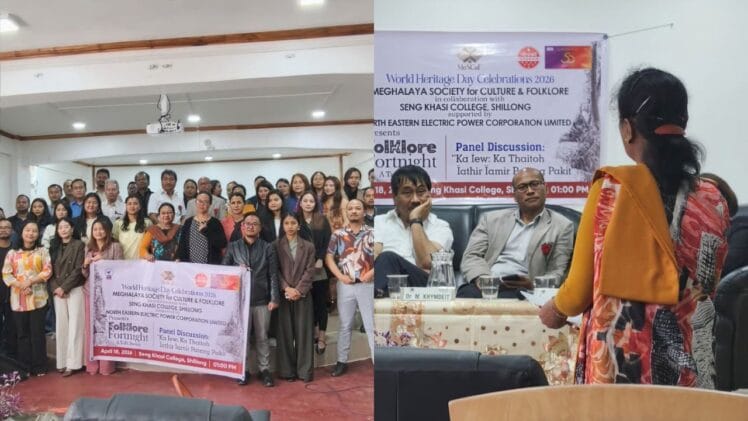
SHILLONG: In a celebration that blended scholarship, culture, and indigenous identity, the Meghalaya State Council for Arts and Culture (MeSCaF), in collaboration with Seng Khasi College, observed World Heritage Day 2026 with a thought-provoking programme centred on the enduring relevance of Khasi folklore and traditional institutions.
Held at the college campus, the event was anchored around this year’s global theme—“Emergency Response for Living Heritage in Contexts of Conflicts and Disasters”—but brought it closer to home through a uniquely Khasi lens. The highlight of the day was a panel discussion titled “Ka Iew: Ka Thaitoh Iathir Iamir Pateng Pakit”, which explored the cultural, social, and political significance of traditional marketplaces in Khasi society.
The programme opened with a welcome address by Principal Dr. Herina Dohtdong, who greeted students, panelists, and dignitaries, while also introducing the moderator, Desmond L. Kharmawphlang—a towering figure in Northeast India’s folklore studies.
In his opening remarks, MeSCaF President Dr. Pynjanai Mallai emphasised that heritage extends far beyond monuments. “World Heritage Day is not just a day—it is a reminder of who we are,” he said, underscoring that for indigenous communities, heritage is embedded in rituals, everyday life, and the natural world. He also highlighted MeSCaF’s efforts to promote folklore studies across educational institutions in Meghalaya, rooted in indigenous research methodologies.
A cultural interlude by NEHU research scholar Daphilahun N. Daloi set the tone, as she performed a soulful Khasi song that echoed the themes of identity and continuity.
The panel discussion that followed transformed the concept of Iew—the traditional market—into a living metaphor for Khasi society. Dr. Etawanda Saiborne of St. Anthony’s College described the market as “a space for knowledge, information, and cultural exchange,” noting that places like Iew Musiang historically held ritualistic significance beyond commerce.
Adding a deeper historical perspective, Païem Laborius M. Syiem stressed the urgency of cultural revival. “Revival is survival,” he asserted, warning that the erosion of indigenous practices could lead to irreversible loss. He also highlighted the inclusive nature of Khasi markets, referencing the historical participation of dkhar (non-tribal) traders in Iewduh.
Moderator Kharmawphlang drew a striking parallel between Khasi markets and classical philosophical traditions, remarking, “The Iew is a university. Plato taught in a market,” suggesting that spaces of exchange have always been spaces of learning and democratic thought.
This idea was further expanded by Asst. Prof. Sadon K. Blah, who argued that the foundations of democracy can be traced back to the marketplace. “Freedom of choice begins in the market before it reaches politics,” he said, describing the Iew as a critical site for understanding electoral behaviour and grassroots political dynamics.
Dr. Marbhador Khymdeit offered a more personal reflection, recalling how markets once served as the primary social hubs where communities gathered, exchanged goods, and built relationships. He pointed out that markets also shape identity, with specific foods and traditions—like Tungrymbai or Sohra jadoh—becoming synonymous with particular places. He also cited examples from Ri Bhoi, where barter systems still persist, fostering community bonds.
An engaging Q&A session followed, with students actively participating in discussions that bridged academic theory and lived experience. The event concluded with a flute recital by student Rahjingshai Kurbah, adding a serene cultural close to an otherwise intellectually vibrant day.
Delivering the vote of thanks, MeSCaF General Secretary Barikupar Paswett acknowledged the contributions of the college, panelists, and participants in making the programme a success.
More than just a commemorative event, the programme served as a reminder that heritage is not static—it lives, evolves, and must be actively preserved. In the Khasi context, the Iew stands not merely as a marketplace, but as a dynamic institution where culture, economy, and democracy converge—an enduring testament to the resilience of indigenous knowledge systems.