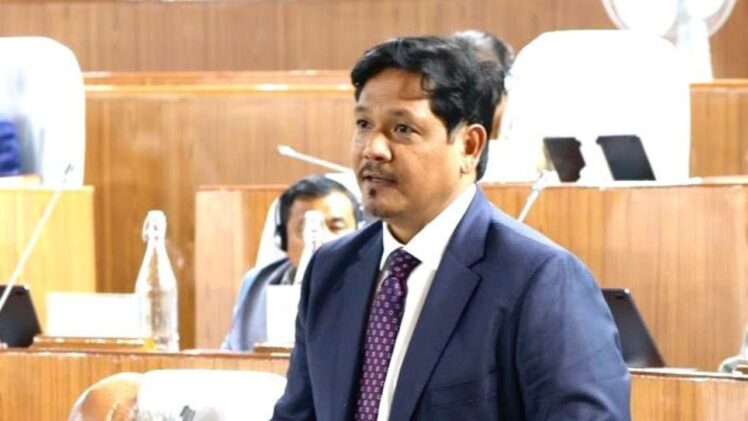
SHILLONG: Chief Minister Conrad K. Sangma today issued a firm defense of Meghalaya’s five-decade-old reservation framework, cautioning the Legislative Assembly that any attempt to alter the current 1972 policy could invite strict judicial scrutiny and potentially dismantle the state’s existing protections.
Replying to a Zero Hour Notice and a Short Duration Discussion initiated by the Voice of the People Party (VPP), the Chief Minister acknowledged that while the state’s 85% reservation for Scheduled Tribes appears to conflict with the Supreme Court’s 50% cap established in the Indra Sawhney case, its long-standing continuity offers a unique layer of legal protection.
“The present policy, having existed for more than 50 years, has a lesser possibility of judicial review,” Sangma stated.
“The introduction of a new policy could open the door to stricter judicial intervention. If a new policy were forced to face the touchstone of judicial review today, it might not succeed in the eyes of the law.”
The discussion was sparked by VPP President and Nongkrem MLA Ardent Miller Basaiawmoit, who argued that the Khasi-Jaintia community felt “great shock” over the Expert Committee’s recommendation to maintain the status quo. Basaiawmoit proposed increasing the Khasi-Jaintia quota to 47% while leaving the Garo quota at 40%, arguing that the legislature should not “fight shy” of making bold decisions due to fear of the courts.
However, the Chief Minister countered this by citing Supreme Court precedents which dictate that population alone is not a valid criterion for determining reservation percentages.
“It is repeatedly enunciated by the Supreme Court that mere population is not a criteria for deciding the percentage of reservation,” Sangma noted, emphasizing that “backwardness” remains the primary constitutional parameter.
He added that the Expert Committee found no compelling evidence from stakeholders that “backwardness” was the driving force behind the demands for a revised tribal split.
The Chief Minister highlighted three key findings from the Expert Committee’s report:
The 85% Ceiling: While exceeding the 50% national cap, the 1972 policy is “protected by its own longevity.”
Proportionality: Demands for change were largely based on population figures rather than constitutional metrics of backwardness.
Stakeholder Consensus: The “major chunk” of stakeholders consulted by the committee expressed a desire to retain the current policy rather than risk losing it entirely through a court challenge.
“To equate unequals is to perpetuate inequality,” Sangma said, quoting judicial observations to justify the state’s specific reservation strategy. He argued that the current system is designed to offset historical imbalances and that the focus should remain on “stricter implementation” rather than structural changes.
Earlier in the session, Ardent Miller Basaiawmoit maintained that the VPP was not seeking to “take away the rights” of the Garo community but was presenting the “facts” of a growing educated youth population in the Khasi-Jaintia region that requires more opportunities.
He dismissed the government’s judicial fears, noting that courts rarely interfere in policy matters unless they are patently illegal.