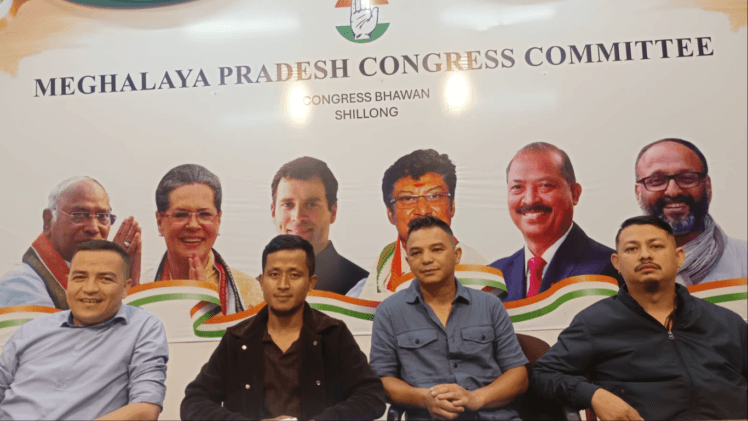
SHILLONG: Congress leader Banphira Basaiawmoit has strongly criticized the Centre’s Foreign Contribution (Regulation) Amendment 2026, accusing the Bharatiya Janata Party (BJP) and Rashtriya Swayamsevak Sangh (RSS) of using the law to control civil society, institutional properties, and minority-run organizations.
Addressing reporters, Basaiawmoit highlighted major structural flaws in the amendment, notably the new provision allowing a designated authority under the Ministry of Home Affairs to seize, sell, and divert the assets of non-compliant NGOs into the Consolidated Fund of India.
Basaiawmoit expressed deep apprehension about the practical fallout of the legislation, outlining five key issues confronting non-profit organizations in the region. The first concern relates to mixed assets created with joint funding.
Citing the example of a ten-classroom school where seven classrooms were built through local contributions, he questioned whether such community-backed properties would be arbitrarily seized and handed over to the central government under the amendment’s permanent vesting clause.
He also flagged the newly introduced funding caps and operational mandates. Under the new rules, NGOs must implement schemes worth at least ₹10 lakh over two years; failure to meet this threshold in sectors like education or healthcare will result in immediate cancellation of their FCRA license and government takeover.
Additionally, the amendment prohibits parent NGOs from distributing foreign resources to sister organizations within the same city or state. Basaiawmoit noted that, for example, a Shillong-based NGO would no longer be able to support its branch units in rural Ri-Bhoi or western Meghalaya without risking non-compliance and asset confiscation.
ALSO READ: Meghalaya CM Meets Rijiju Over FCRA Amendment Bill, Raises Concerns of Christian Orgs
Highlighting administrative hurdles, Basaiawmoit criticized the requirement that all foreign funds be routed exclusively through the State Bank of India’s main FCRA branch in New Delhi, warning that this centralized process could cause dangerous delays during local disasters or emergencies in Meghalaya.
According to Basaiawmoit, these changes are aimed at crippling minority-run—specifically Christian—institutions that operate in remote rural areas where government presence is minimal. He noted that Christian educational institutions in Meghalaya have long championed progressive, science-based education.
Continuing his critique, Basaiawmoit accused the BJP and RSS of undermining scientific temper across the country by promoting unscientific research and removing key concepts like Darwin’s theory of evolution from NCERT textbooks.
He asserted that the FCRA amendment is part of a broader agenda—including the Citizenship Amendment Act (CAA), One Nation One Election, One Nation One Language, One Nation One Religion, and the Uniform Civil Code—intended to systematically erode the distinct religious and cultural identities of the Khasi, Jaintia, and Garo communities.
Drawing inspiration from recent student protests in New Delhi, Basaiawmoit called on all political parties, civil society organizations, and local stakeholders in Meghalaya to unite against the legislation, emphasizing that collective public action is the most effective way to challenge these contentious policies.
(4FrontMedia news)