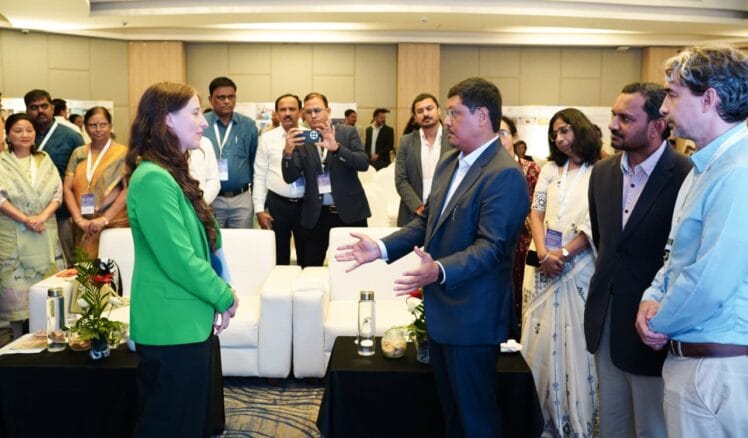
SHILLONG: Meghalaya Chief Minister Conrad K. Sangma today inaugurated the three-day ECD (Early Childhood Development) Implementation Science Workshop at Vivanta, Shillong, bringing together policymakers, development practitioners, experts, and stakeholders from across the country to strengthen integrated systems for early childhood development.
The workshop is being organised under the Meghalaya Early Childhood Development Mission (MECDM) in collaboration with the State Capability Enhancement Project (SCEP), the Van Leer Foundation, and the Asian Development Bank (ADB).
Held under the theme, “From Science to State Action — Building Integrated Systems for Early Childhood Development,” the workshop seeks to translate scientific evidence, global learning, and policy priorities into practical actions that improve outcomes for children and families.
Addressing the gathering, Chief Minister Conrad K. Sangma said that one of the guiding principles of his administration since assuming office in 2018 has been the belief that meaningful change does not always require new schemes or policies, but rather better implementation of existing ones.
Recalling a question posed by the media when he first became Chief Minister, he said he had drawn inspiration from author Shiv Khera and responded that he “would not do anything different, but would do things differently.”
The Chief Minister noted that both Central and State Government schemes are largely designed to address existing developmental challenges and that the real challenge often lies in implementation. He pointed out that improvements in implementation have led to significant gains across sectors in Meghalaya.
Referring to MGNREGA, he said that stronger execution had resulted in a nearly threefold increase in utilisation and absorption capacity. Similar improvements, he added, have been achieved across departments, leading to a four- to five-fold increase in the utilisation of centrally sponsored schemes and externally aided projects. He noted that Meghalaya is currently implementing nearly ₹12,000 crore worth of externally aided projects, exceeding the portfolio of many other small states.
Emphasizing the importance of political and administrative leadership, Sangma said that while governments often understand the science, evidence, and data behind development challenges, progress ultimately depends on the collective will to act.
“The point I am trying to make is that we often know the problems. We understand the science, the data and the analysis behind them. But ultimately, there has to be a will to make a difference,” he said.
He added that the role of leadership is to identify capable individuals, place them in positions where they can contribute effectively, and provide them with the confidence and support needed to perform.
The Chief Minister stressed that governments do not always need entirely new ideas but rather a stronger capacity to implement existing ideas effectively. He underscored the importance of having a shared vision and clarity of purpose, while also recognising that no single model can be applied uniformly across different contexts.
Drawing on Meghalaya’s experience in addressing maternal mortality, Sangma said that the State initially assumed that increasing institutional deliveries would solve the problem. However, a deeper analysis revealed that the real barriers were economic and logistical in nature, including transportation costs, distance, and the lack of support systems for expectant mothers.
“We were encouraging institutional deliveries without recognising the economic realities these mothers faced,” he said.
He explained that instead of investing in a large fleet of ambulances, the government leveraged existing community resources by creating a system through which local vehicle owners could transport expectant mothers and receive compensation for their services. The State also established Safe Motherhood Homes to support women from remote areas during the final stages of pregnancy by providing accommodation, food, care, and financial assistance for both the mother and a companion.
“The lesson here is that we must identify where the actual problem lies and then design solutions that are practical, affordable and tailored to local realities,” he said.
The Chief Minister also emphasized the importance of focusing on outcomes rather than outputs. Referring to preparations for the National Games, he noted that the completion of infrastructure projects alone should not be regarded as success.
Citing the recently completed ₹160-crore indoor stadium, he said the true measure of success would be reflected in the achievements of young athletes and the positive impact sports have on their lives. “We must always remember the larger purpose behind our work,” he said.
Sharing another example, Sangma recalled a conversation with an engineer who considered the number of kilometres of canals constructed as the measure of success. “I told him that he was mistaken. The true measure of success is how much agricultural production increases because of those canals. The canal itself is not the objective; improving people’s lives is,” he remarked.
He noted that this focus on outcomes led the government to adopt a more integrated approach to development. Discussions with Additional Chief Secretary Sampath Kumar and other officials reinforced the understanding that maternal mortality, infant mortality, and early childhood development are not isolated issues but are interconnected aspects of an individual’s life journey.
This thinking ultimately led to the creation of the MOTHER programme—Meghalaya’s Outcome and Transformation in Health, Education, Rural Development and Social Benefit—which brings together multiple departments around a common focus on the mother and child.
“We are no longer looking at departments or schemes in isolation. We are looking at a human life and asking how government can support that life at every stage,” the Chief Minister said.
He further observed that maternal and child health outcomes are closely linked to economic empowerment. The government found that many young mothers experienced frequent pregnancies because of limited economic opportunities and financial independence. This understanding informed the State’s efforts to strengthen Self-Help Groups, not only as an economic initiative but also as a strategy for improving health and social outcomes. Over the last eight years, the number of Self-Help Groups in Meghalaya has grown from approximately 4,500 to nearly 60,000.
Highlighting the value of cooperative federalism, Sangma said that there are no small states or big states when it comes to innovation and good governance. He noted that Meghalaya has learned from states such as Odisha, Maharashtra, Andhra Pradesh, and Sikkim, and stressed that states must continue learning from one another through platforms that encourage collaboration and knowledge exchange.
“That is the true spirit of cooperative federalism—not only cooperation between the Centre and the States, but cooperation among States themselves,” he said.
The Chief Minister said that workshops such as the present one provide valuable opportunities to exchange ideas, strengthen partnerships, and deepen understanding of the diverse experiences of different regions of the country. He expressed hope that many more such engagements would be organised in the future and reiterated the collective responsibility of governments and stakeholders to ensure that every child reaches his or her full potential, that no mother loses her life unnecessarily, and that every citizen receives the support needed to live a meaningful and dignified life.
Concluding his address, Sangma congratulated the organising team for convening the workshop and described the presentations and discussions as insightful and valuable. He wished all participants a productive workshop and called on stakeholders to continue learning from one another while working together in service of the people.
Following the Chief Minister’s address, Patricia Núñez Zamora of the Van Leer Foundation shared Chile’s experience in developing and implementing a comprehensive Early Childhood Development system known as “Chile Crece Contigo” (Chile Grows With You), highlighting key lessons on overcoming implementation challenges. She noted that while the science of ECD is well established, the greatest challenge lies in translating evidence into action.
Zamora explained that Chile’s journey began with a fundamental question: “What does it mean to be a society that supports children and parents?” She emphasized that implementation challenges are rarely due to a lack of resources, but rather to the difficulty of bridging the gap between policy and practice.
She highlighted the importance of participatory design, recalling how Chile established a Presidential Advisory Council comprising experts from multiple disciplines to develop a shared diagnosis and recommendations. “Co-design is not simply a procedural exercise. It creates ownership among the people who will ultimately be responsible for implementation,” she said.
Zamora explained that the resulting Chile Crece Contigo system provides personalised support from pregnancy through childhood, linking health, education, and social protection services through coordinated monitoring and intervention mechanisms. She stressed that the initiative is not merely a programme but a coordination architecture designed to make existing services work together for the same child and family.
“The problem was never the absence of services. The problem was that services were not working together with a shared view of the child and family,” she noted.
Reflecting on nearly two decades of implementation, she said the most important lessons from Chile’s experience are that implementation must be viewed as a system rather than a project, coordination must be treated as a core policy function, and sustainability must be deliberately built through legal and institutional arrangements. She also highlighted the importance of addressing the “last mile” challenge of ensuring that policies translate into meaningful action in communities and frontline services. Concluding her presentation, Zamora described Chile Crece Contigo as an ongoing effort to answer the question of what it means to be a society that truly supports children and parents.
Prakash Kumar Paul, Country Head of the Van Leer Foundation, described the workshop as a platform for learning, collaboration, and action in Early Childhood Development. He stressed the importance of breaking departmental silos and fostering greater collaboration among states and sectors, noting that ECD is a shared responsibility that requires coordinated efforts.
Paul explained that while previous leadership workshops focused on understanding the “what” and “why” of ECD, the present technical workshop is focused on the “how” of implementation. He said the sessions are designed to equip participants with practical tools and frameworks while also creating a network of ECD champions who can work together to improve outcomes for young children. He further highlighted the value of knowledge exchange, innovation, and recognising successful interventions, expressing confidence that the workshop would lead to stronger partnerships and meaningful action plans across states.
Providing the context for the workshop, Additional Chief Secretary Sampath Kumar highlighted Meghalaya’s journey in advancing Early Childhood Development through integrated governance and collaborative leadership. He noted that since adopting the vision of becoming a developed state, Meghalaya has invested significantly in strengthening institutions, leadership, and public service delivery systems.
Kumar said the State’s ECD journey was guided by scientific evidence demonstrating the importance of the early years in shaping lifelong outcomes. These learnings led to the establishment of the Meghalaya Integrated Early Childhood Development Mission under the leadership of the Chief Minister, making Meghalaya one of the first regions in the Asia-Pacific to implement a comprehensive integrated ECD mission.
The three-day workshop brings together government officials, development partners, practitioners and experts to deliberate on key issues relating to early childhood development, parental well-being, behavioural science, adaptive leadership and systems strengthening. Through technical sessions, collaborative discussions and field immersion activities, participants will explore practical approaches to translating research and evidence into effective state action.