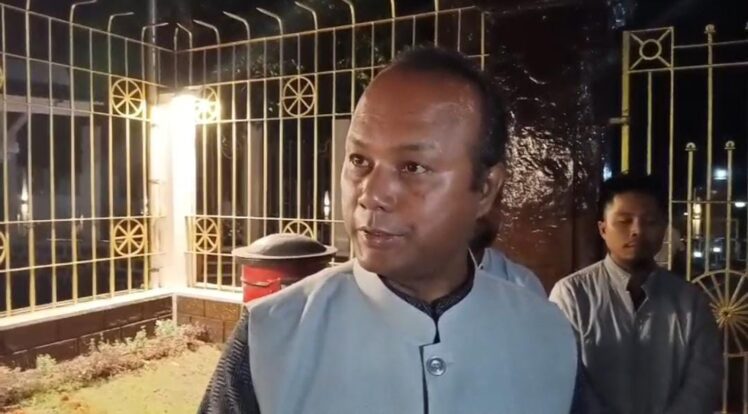
SHILLONG: Tura MDC Bernard N. Marak launched a blistering critique against the state leadership and the Congress party, labeling the recent turmoil in Garo Hills a “mass movement” triggered by political failure.
In a series of explosive statements, Marak pinned the blame for the escalating tensions squarely on the shoulders of dilatory political leaders, while simultaneously dismissing allegations leveled by the Congress party.
Marak didn’t hold back when addressing claims from the Congress camp, effectively turning the tables on his political rivals. He alleged that the spark for the current unrest was a Congress candidate—a non-tribal former MLA and MDC—who attempted to file a nomination despite fierce local opposition.
“Who started the fire?” Marak questioned. “Stop pointing at anybody without verifying the facts. This isn’t about political parties; it’s a mass event where the youth and the public have risen up due to the negligence of leaders who ignored the situation in Garo Hills.”
Marak clarified that those arrested are not pawns of any political group but are part of a broader civil society outcry. He demanded the immediate release of arrested leaders and youths, arguing that the government’s failure to respond to local grievances is what caused the situation to spiral.
Addressing the controversial six-month extension of the District Council term, Marak made a bold call for Governor’s Rule. While he acknowledged the extension is necessary to rectify issues like illegal migration and the implementation of SIR (Social Impact Reform) in plain and hill areas, he argued against leaving power in the hands of the current Executive Committee.
The Expiry: Current terms end April 18.
The Demand: Instead of favoring specific political parties, the Governor should take direct control of the District Council.
The Warning: Marak warned that leaving it to committees could drag the process out for “one or two years,” serving only the “political privilege” of a few.
On the sensitive issue of targeting specific communities, Marak offered a nuanced take. He insisted that bonafide non-tribal citizens (both Hindu and Muslim) respect the Sixth Schedule and primarily seek voting rights as taxpayers who follow District Council rules.
However, he drew a firm line at representation:”There are certain groups who want to be part of the elected representative body, which is not constitutionally permissible.”