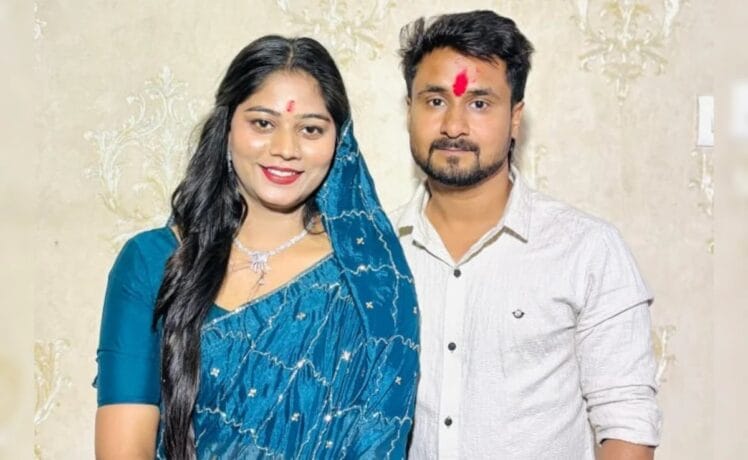
SHILLONG: She was supposed to be on the honeymoon of her dreams. Instead, on 23 May 2025, Raja Raghuvanshi and his new wife Sonam disappeared while trekking through the breathtaking, mist-covered hills of Sohra, better known to the world as Cherrapunji in Meghalaya, just days after their wedding in Indore. What followed was one of the most shocking criminal cases in recent Indian memory.
And today, in a twist that has stunned the nation all over again, the woman accused of masterminding her husband’s murder walked free on bail. Not because she was found innocent. But because the police could not get their paperwork right.
THE ROMANCE THAT WAS NEVER A ROMANCE
Raja and Sonam Raghuvanshi were married on 11 May 2025 and left Indore for Meghalaya on 20 May to begin their honeymoon. On 22 May, the couple arrived at Mawlakhiat village near Cherrapunji and trekked about 3,000 steps down to the famous double-decker living root bridge at Nongriat, where they stayed overnight. It was the kind of setting that belongs on a postcard — cascading waterfalls, ancient root bridges, the greenest gorges on earth.
But investigators would later allege that what looked like a honeymoon was actually an execution in slow motion. Sonam and her alleged lover Raj Singh Kushwaha had allegedly planned Raja’s murder multiple times, succeeding only on their fourth attempt near Wei Sawdong Falls on May 23. Three hired assailants attacked Raja with machetes while Sonam was present, then dumped his body in a gorge.
On 2 June 2025, a National Disaster Response Force drone spotted Raja Raghuvanshi’s body at the base of a gorge under the Wei Sawdong Falls in Sohra. The body was badly decomposed. Raja’s brother identified him by a tattoo on his right hand.
A nation held its breath.
THE PLOT THE CHARGESHEET REVEALED
When the Meghalaya Police filed their chargesheet, it ran to 790 pages. The chargesheet named five primary accused, including Raja’s wife Sonam Raghuvanshi, her alleged lover Raj Singh Kushwaha, and three hired assailants. A Special Investigation Team from East Khasi Hills pieced together the case using call records, travel history, financial transactions, and digital footprints. The post-mortem confirmed multiple head injuries inflicted by sharp weapons.
Investigations revealed that Sonam and Kushwaha had continued their illicit affair even after Sonam’s marriage to Raja on 11 May 2025. Police said Raja was allegedly killed by Akash Singh Rajput, Vishal Singh Chauhan and Anand Kurmi in Sonam’s presence. In total, eight individuals were arrested in connection with the case.
On 9 June 2025, the Meghalaya Police arrested Sonam Raghuvanshi from Ghazipur, Uttar Pradesh, on charges of conspiracy to murder. She had initially claimed she was drugged and abandoned. She was found at a dhaba on the Varanasi-Ghazipur main road.
Raja’s mother demanded the death penalty. His brother Vipin demanded a CBI probe. The country was outraged. The case seemed watertight.
It was not.
THE MOMENT EVERYTHING UNRAVELLED
On 27 April 2026, nearly eleven months after Raja’s body was pulled from that gorge, the District and Sessions Court in Shillong took up Sonam’s fourth bail application. What Judicial Officer Smti D.R. Kharbteng found when she examined the arrest documents was, by any measure, extraordinary.
Every single document pertaining to Sonam’s arrest, the checklist for justification of arrest, the memo of arrest, the inspection memo, the intimation of rights of the arrested person, and the extract from the case diary, cited the wrong section of the law. Sonam had been arrested in connection with a murder under Section 103(1) of the Bharatiya Nyaya Sanhita (BNS). But across all documents without a single exception, the investigating team had written Section 403(1) BNS. She was never, in any official document, told she was being arrested for murder.
And it did not end there. The intimation of grounds of arrest that was handed to her at the time of her arrest was a generic printed format, a checklist of possible accusations. Not one checkbox had been ticked. It was, in the court’s plain assessment, a blank form handed to a woman accused of organising her husband’s killing, and nothing more.
When the prosecution tried to argue this was a simple clerical error, the court was unmoved. An error that appears once might be clerical. “Though it has been argued that this is a clerical error, however such error cannot occur in all documents,” the court order stated.
THE CONSTITUTIONAL WALL THE POLICE RAN INTO
The court’s order drew heavily on a line of landmark Supreme Court judgments that have, in recent years, drawn an unambiguous constitutional line around the right of every arrested person to be informed of the grounds of their arrest.
The court cited Prabir Purkayastha vs State (NCT of Delhi) (2024), in which the Supreme Court held that the requirement to communicate grounds of arrest in writing is sacrosanct and cannot be breached under any situation, and that filing of a chargesheet does not validate the illegality committed at the time of arrest.
It cited Vihaan Kumar vs State of Haryana (2025), in which the Supreme Court went further and laid down a six-point conclusive framework, among which was the ruling that when a violation of Article 22(1) is established, it is the duty of the court to order the release of the accused forthwith, and that this power to grant bail overrides even statutory restrictions.
Critically, the court also drew on Labius Arengh vs State of Meghalaya (2026), a judgment from the Meghalaya High Court itself, in which a similarly defective checklist format for communicating grounds of arrest had been found to be contrary to law.
The difference between the prosecution’s best hope, the Darshan judgment from the Supreme Court in 2025, and this case was stark. In Darshan, the accused had been represented by counsel from the outset, had applied for bail immediately after arrest, and demonstrable prejudice to their defence could not be established. In Sonam’s case, there was no counsel when she was first produced before a court at Ghazipur. The wrong section of law appeared across every document. She was never told in any legally meaningful way that she was being arrested for murder. Prejudice to her defence was, in the court’s finding, established.
The court ordered her released on bail with conditions: a personal bond of Rs 50,000, two sureties of like amount, no travel outside the court’s jurisdiction without permission, and appearance on every date fixed.
THE QUESTION NO ONE WANTS TO ANSWER
The question arises: How a Special Investigation Team that produced a 790-page chargesheet, that tracked call records, financial transactions, and digital footprints across state lines, that located and arrested a suspect in Ghazipur, managed to get the section of law wrong in every single piece of arrest documentation it produced?
Article 22(1) of the Constitution of India is not an obscure provision. It is one of the most fundamental protections in Part III. The requirement to communicate grounds of arrest has been the subject of landmark Supreme Court judgments. The SIT was not a district police outpost. It was a specially constituted team assigned to one of the highest-profile cases in the country.
The Shillong Police had arrested eight individuals in connection with this case. The investigation produced voluminous documentation. And yet, the one document that the Constitution requires to be specific, personal, and meaningful to the individual being arrested, was a blank form with no boxes ticked and the wrong section of law on every page.
Raja Raghuvanshi was hacked to death in a gorge beneath a waterfall while on his honeymoon. His family has waited nearly a year for justice. Today, they received instead a reminder that in the Indian criminal justice system, how you make an arrest can matter as much as why you made it.
The trial continues. Bail is not acquittal. Sonam Raghuvanshi remains an accused. The court has been explicit that the chargesheet, the evidence, and the prosecution are unaffected by this order.
But somewhere in Indore tonight, a family is asking a question they should never have had to ask. Not about the courts. Not about the Constitution. About the police officers who were handed one of the country’s most watched cases, and could not fill in a form correctly.