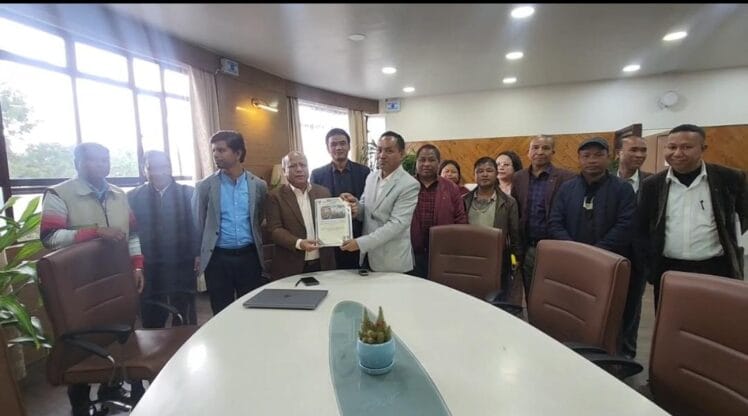
SHILLONG: The central body of the Meghalaya School Welfare Development Association (MSWDA) met with the Deputy Chief Minister of the state, Prestone Tynsong, to express concerns regarding the condition of Secondary and Higher Secondary schools in the state, which has significantly impacted the future of students.
During the meeting, MSWDA leader HM Marbaniang stated that the primary issue the government must address is the improvement of schools at the Secondary and Higher Secondary levels to curb the high dropout rates occurring once students reach these stages.
He explained that this situation arises because parents can no longer afford high school fees since the schools themselves cannot operate without financial assistance from the government, leading many children to abandon their studies midway.
In response, Prestone Tynsong assured that just as the government has already addressed the needs of approximately 9,000 Lower Primary (LP) and Upper Primary (UP) schools, it will now take serious steps to bring necessary improvements to the 1,400 Secondary and Higher Secondary schools. While acknowledging that the government requires time to systematically resolve these issues, he clarified that the intention is to improve these schools, even if it is done in a phased manner.
The MSWDA emphasized that the Secondary and Higher Secondary levels form the foundation for educational advancement, making it crucial for the government to take immediate action to enhance the quality of education in these categories to uplift the overall educational standards of the state.
This demand has been consistently pursued since last year, with the association previously meeting the former Education Minister, Rakkam A Sangma, on April 4, 2025, who had also expressed concern over the matter.
The association has further met with the new Minister of the department, Lahkmen Rymbui, to present six key demands.
The MSWDA has collected detailed information from the Directorate and District School Education Officers (DSEOs) across all 11 districts to substantiate the urgent need for government assistance to Secondary and Higher Secondary schools as a vital measure to prevent students from dropping out in the state.