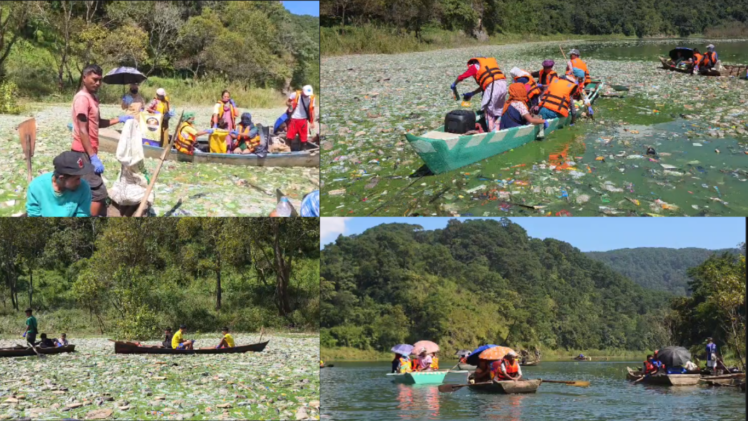
MAWDUN: Behind the postcard-perfect panoramas that draw thousands to Meghalaya’s scenic overlooks lies a mounting environmental emergency, prompting a powerful coalition of local villagers and environmental advocates to take matters into their own hands.
In a determined push to rescue one of the state’s most critical natural lifelines, the Green-Tech Foundation (GTF), alongside the resilient residents of Mawdun, spearheaded a massive, ground-level clean-up drive at Wah Iap-Ngor.
This strategic location acts as the primary catchment choke point where heavy solid waste, carried down from the urban centers via the heavily burdened Wah Umkhrah and Wah Umshyrpi rivers, converges before it can disperse across the wider expanse of Umiam Lake.
The large-scale intervention was designed to intercept and pull colossal quantities of accumulated debris out of the water before natural currents could drag the floating waste deeper into the reservoir.
Beyond its fame as a premier tourism jewel, Umiam Lake serves a far more critical function as the foundational reservoir powering Meghalaya’s vital 172 MW hydroelectric installation.
Addressing the media during the intensive operation, H. Bansiewdor Nonglang, Chairman of the Green-Tech Foundation, laid bare the stark realities confronting the water body, warning that the crisis demands immediate, systemic intervention rather than passive admiration from afar.
“As a Foundation, we cannot simply stand by and watch the condition of Umiam Lake deteriorate,” Nonglang stated, highlighting that more than 40,000 cubic metres of silt and sediment pour into the basin every single year, quietly eroding the long-term viability of the state’s energy grid.
“Today, we are not here merely to conduct another cleaning drive. We are here because we believe that every tonne of waste we remove, every stretch of the river we restore, and every intervention we make to prevent further pollution is a step towards protecting Umiam Lake.”
Nonglang stressed that while volunteer-driven clean-ups successfully haul away hundreds of tonnes of refuse, treating surface symptoms will never be enough. The ultimate battle must be won upstream by cutting off the flow of waste at its source.
Challenging public complacency, the Chairman noted that the picturesque scenes captured from popular vantage points like Ryndang Briew entirely mask the profound ecological pressures simmering beneath the glittering surface.
”This is not about blaming the Government, the public, or any particular individual,” Nonglang urged.
“It is about recognising the seriousness of the problem and accepting that protecting Umiam requires collective responsibility, scientific intervention, and sustained action.”
Directing a sharp appeal to the residents of Shillong and regional stakeholders, the Foundation emphasized that the capital city must wake up to the reality that Umiam is an irreplaceable utility rather than an expendable recreational backdrop.
The GTF called upon the State Government to bridge existing gaps by uniting local communities, technical experts, civil society groups, and environmental organizations under a single, coordinated master plan, rather than leaving the heavy lifting to individual villages and grassroots NGOs.
To secure the reservoir’s future, the Foundation outlined a comprehensive five-pillar restoration framework: aggressive river rejuvenation and waste interception along urban tributaries; scientific monitoring of sediment inflow, bathymetry, and storage capacity to guide proper dredging; large-scale catchment afforestation and land restoration to check topsoil erosion; continuous, institutionalized municipal waste collection protocols; and inclusive multi-stakeholder governance platforms.
Furthermore, the Foundation issued a firm caution regarding commercial expansion around the water body, asserting that proposals for luxury hotels and heavy commercial developments must be rigorously vetted against the lake’s ecological carrying capacity.
Protecting a vital hydropower reservoir and natural ecosystem, they maintained, must always supersede commercial ambitions that risk compromising the state’s future.
”Umiam does not need us to compete over who is responsible for its condition. It needs us to work together to change that condition,”
Nonglang concluded. “We cannot build a future for Meghalaya by neglecting the very natural resources that sustain it. Its future depends entirely on what we choose to do today.”
(4FrontMedia news)