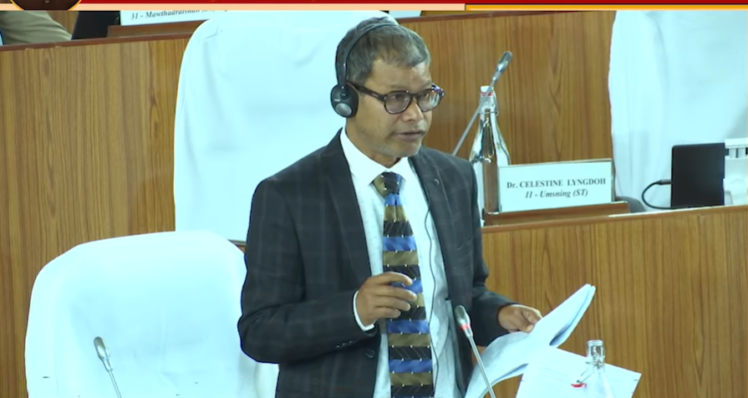
SHILLONG: Cabinet Minister Lahkmen Rymbui has affirmed that despite Meghalaya’s complex and multi-layered land tenure system, all land transactions and acquisitions in the state are governed strictly by the rule of law.
Replying to a special motion on increasing alienation of tribal lands in the state during the ongoing Budget Session of the Meghalaya Legislative Assembly, Rymbui acknowledged that land management in Meghalaya is “tricky” due to the involvement of multiple stakeholders, including clans, Raid, Hima, Elaka, Autonomous District Councils, and private individuals. However, he stressed that there has been no forceful encroachment or unlawful alienation of land.
The Minister explained that land administration in Meghalaya is primarily vested in the Autonomous District Councils under the Sixth Schedule of the Constitution, while the State Government exercises concurrent powers.
He outlined the legal frameworks governing different regions:
-
Garo Hills: Regulated by the Garo Hills Autonomous District Council Land and Revenue Regulation (1954)
-
Khasi Hills: Governed by the Khasi Hills Autonomous District Council Regulations and Annulment of Land Act (2021)
-
Jaintia Hills: Managed under the District Council Management and Control over Land and Assessment and Collection of Revenue Act (1985)
While the ADCs oversee most land matters, Rymbui noted that the State’s Revenue and Disaster Management Department remains responsible for Government (Revenue) Land and regulates transfers between tribals and non-tribals.
To improve transparency and coordination, the Minister said the government follows the Meghalaya Land Survey and Record Preparation Act (1980).
He added that a 1991 amendment ensured District Councils’ participation in cadastral surveys, with the State Government providing technical and functional support.
This collaborative approach, he said, has helped modernise land records while respecting traditional ownership systems.
Reaffirming the importance of customary institutions, Rymbui stated:
“No land is being acquired without the proper No Objection Certificate from the Headman, Doloi, or Nokma.”
He emphasized that traditional authorities remain central to the legal process and serve as key safeguards against illegal land transactions.
On major infrastructure projects, the Minister said land acquisition for highways is carried out under the National Highways Authority of India Act (1956).
He assured that mandatory public hearings are conducted, Deputy Commissioners ensure compliance with procedures and affected persons can approach notified arbitrators if dissatisfied with compensation.
These measures, he said, ensure fairness and legal protection for landowners.
Rymbui stated that the government continues to engage with District Councils to modernise land records while preserving customary laws governing community and Hima lands.
He reiterated that development and infrastructure expansion in Meghalaya will continue in a manner that respects tradition, legality, and community rights.