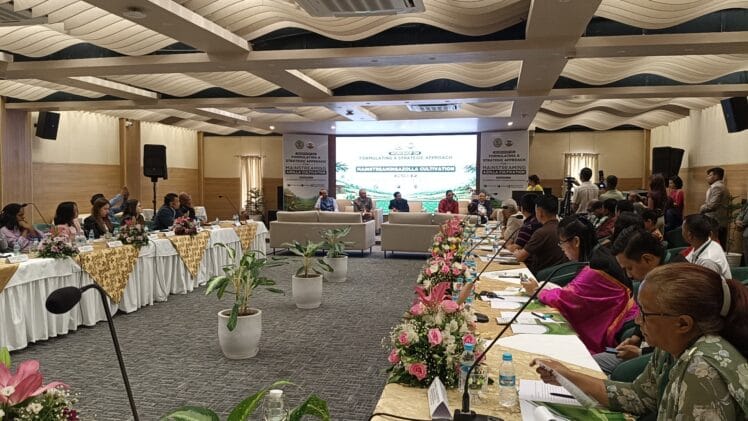
SHILLONG: The Meghalaya Farmers’ (Empowerment) Commission on Friday organised a one-day workshop on “Formulating a Strategic Approach for Mainstreaming Azolla Cultivation” at the State Guest House, Taraghar, with an aim to promote azolla as an organic bio-fertiliser, livestock feed, and commercially viable bio-product.
The workshop brought together experts, officials, and stakeholders to deliberate on scientific methods and sustainable strategies for expanding azolla cultivation across Meghalaya. Technical sessions focused on cultivation protocols, pond construction techniques, agronomic practices, and value-addition methods to improve the commercial viability of azolla farming.
Addressing the gathering, Meghalaya State Planning Board Co-Chairman Olan Sing Suin said azolla cultivation has the potential to significantly enhance farmers’ income while contributing to sustainable agricultural development in the state.
He stressed the importance of adopting innovative scientific practices to ensure long-term growth in the agriculture and horticulture sectors and assured support for scaling up the initiative if current pilot projects prove successful. He also announced financial assistance for pilot demonstrations in his constituency.
Speaking on the occasion, Meghalaya Farmers’ (Empowerment) Commission Chairman P.S. Thangkhiew said the workshop was organised following extensive district-level consultations, which indicated growing interest among farmers in azolla cultivation.
He underscored the need to standardise cultivation practices to facilitate wider adoption.
Renowned senior scientist Dr. P. Kamalasanan Pillai highlighted azolla’s benefits as a high-protein and climate-resilient crop capable of reducing livestock feed costs, improving farm productivity, and supporting carbon-negative agricultural practices.
Topics:
agricultural innovation Northeast India, azolla commercial farming India, Azolla cultivation Meghalaya, azolla farming benefits India, azolla workshop Meghalaya, bio fertiliser farming techniques, carbon negative farming India, climate resilient crops India, farmer income boost Meghalaya, high protein livestock feed India, livestock feed azolla India, Meghalaya farmers empowerment commission, Meghalaya horticulture development, Olan Sing Suin Meghalaya agriculture, organic bio fertiliser Meghalaya, PS Thangkhiew farmers commission, sustainable agriculture Meghalaya, sustainable farming practices India,