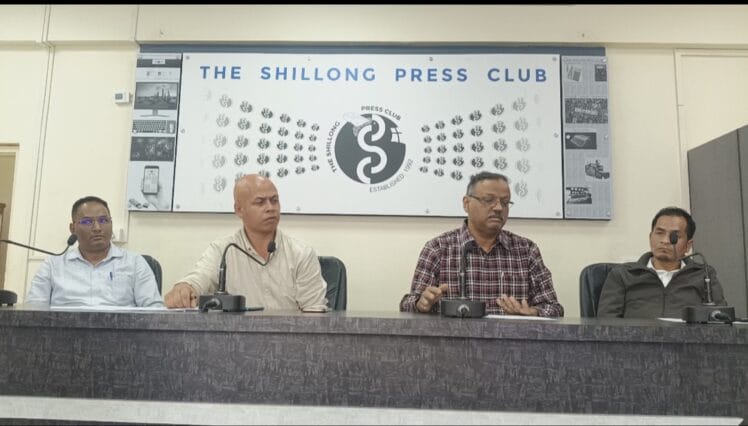
SHILLONG: Representatives of deficit grant-in-aid schools and colleges in Meghalaya have strongly opposed the newly notified Meghalaya Non-Government Schools and Colleges Employees’ Centralised Fund Scheme, 2026, stating that it has been “unanimously rejected” by stakeholders.
Addressing a press conference at the Shillong Press Club, Khasi Jaintia Deficit School Teachers’ Association (KJDSTA) president Boswell Pala said that both teaching and non-teaching staff, including retirees, were not adequately consulted prior to the approval of the scheme.
While acknowledging the importance of pension benefits, Pala pointed out that the 2026 scheme differs significantly from the draft prepared in 2023, which had been mutually agreed upon and forms part of court records. He added that despite objections raised by stakeholders, the government proceeded with implementation following an announcement by Chief Minister Conrad K. Sangma earlier this month.
Pala further explained that employees appointed before April 2010 fall under the Contributory Provident Fund (CPF). While those appointed thereafter are covered by the National Pension System (NPS). He alleged that the new scheme merges these categories, creating confusion among employees.
He also expressed concern over directives requiring employees to open Permanent Retirement Account Number (PRAN) accounts, terming it an attempt to enforce the scheme even as the matter remains sub judice.
Dr P. Sarkhel, Associate Professor at St. Edmund’s College, echoed similar concerns, attributing the opposition to both delays and substantive disagreements with the scheme.
Providing background, Sarkhel said the CPF issue was first taken up in 2017 before the Meghalaya High Court, which issued a favourable judgment directing the government to comply with nine provisions. However, after the 2018 ruling, the state government moved the Supreme Court.
He said that while nine directions were initially issued, directions 4 to 8 were later set aside by the Supreme Court on the grounds that they were not directly related to the relevant Provident Fund Act, while directions 1, 2, 3 and 9 were retained.
Sarkhel noted that deficit schools and colleges across Meghalaya have consistently maintained that they fall under the CPF framework, as reflected in earlier court observations. He added that during proceedings in the Supreme Court, questions were raised regarding the implementation of the Meghalaya Provident Fund Act, which, he claimed, had not been properly enforced since the state’s formation.
He alleged that for decades, the CPF system was administered largely through executive orders rather than in accordance with statutory provisions. This prompted petitioners to raise the issue before the apex court, which subsequently directed the state to clarify the extent of implementation of the Act and remanded the matter to the High Court.
He pointed out that as per notifications issued on May 20, 2023, employees appointed after April 1, 2010 were to be covered under the NPS in line with Government of India norms, while those appointed prior to that date would continue under the CPF framework.
However, he alleged inconsistencies in implementation, noting that while funds of pre-2010 employees were transferred to the centralised provident fund, contributions of post-2010 employees remain in various bank accounts and have not been transferred.
Highlighting the human impact, Sarkhel said many retired teachers have been unable to access their dues, leading to financial hardship. He added that some retirees facing medical emergencies have struggled without access to their savings.
He further stated that during 2023–24, stakeholders had secured favourable court directions to notify a mutually agreed scheme, which had been proposed by the government and accepted by all parties. However, he expressed concern that the newly notified 2026 scheme departs from that agreed framework.
Speaking on behalf of retired educators, Dr B.H. Buam, a retired associate professor, said the matter is currently before the court and therefore detailed comments would be limited. However, she noted that the core issue relates to the implementation and correction of benefits under the CPF framework.
She stressed that stakeholders expect the government to adhere to court directives in both letter and spirit, expressing confidence that the judicial process will ensure a fair outcome.
Expressing disappointment over the newly announced scheme, Dr Buam said it marks a significant departure from the 2023 draft that had been accepted and submitted before the court. She further noted that the earlier framework was linked to provisions under the relevant Act governing CPF-based retirement benefits.
Questioning the applicability of the 2026 scheme to retired employees, she said the annuity-based model appears more suited to new entrants rather than those who have already retired. She also raised concerns over provisions allowing partial withdrawals, stating that such measures undermine the assurance of a secure and stable retirement.
Topics:
Conrad K. Sangma policy, CPF vs NPS Meghalaya, deficit schools colleges Meghalaya, educators financial hardship Meghalaya, Featured, MCTA Boswell Pala, Meghalaya Centralised Fund Scheme 2026, Meghalaya High Court CPF case, PRAN controversy, retirement fund crisis Meghalaya, teachers protest Meghalaya pension scheme,