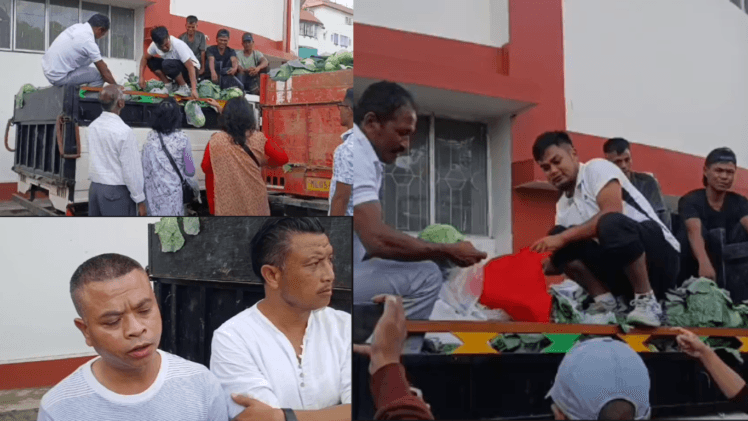
SHILLONG: In a poignant and unprecedented protest, local farmers in Shillong took to the streets today to distribute cabbages for free to the public. This act was born out of deep frustration over the market crash in cabbage prices, which have plunged to a mere ₹2 per kilogram—rendering the hard work of the farming community meaningless.
Commander Shangpliang, President of the Hill Farmer Union, expressed grave concern, stating that at ₹2 per kilogram, selling cabbages is practically equivalent to giving them away. The distribution drive was chosen as a peaceful yet powerful way to draw attention to the severe hardships faced by farmers, whose physical and financial investments have been rendered futile.
To address the crisis, Shangpliang outlined several key demands for the state government. Foremost, the union is urging the immediate constitution of a high-level committee to assess and regulate production and input costs. With such drastic price drops, farmers are unable to sustain their families and livelihoods.
The union strongly called for the implementation of a Market Intervention Scheme to provide financial relief, citing the government’s positive intervention in the past during the broomstick price crash as a precedent. He also questioned the significant price gap, demanding an investigation into why cabbages remain expensive for consumers in retail markets, even as farmers are forced to sell at rock-bottom prices.
A. Kharsyntiew, General Secretary of the union, added that farmers across both East Khasi Hills and West Khasi Hills have been severely impacted. After meeting with affected farmers, the union leaders said that being offered ₹2 per kilogram is a direct insult to their dignity.
ALSO READ: Hill Farmers’ Union Raises Human Rights Concerns Over Blockade in Lapangap Village
Many are now reluctant to even harvest their crops, as the costs of harvesting, packaging, transportation, and labor far exceed any potential returns.
Kharsyntiew illustrated the crisis through simple math: a farmer cultivating cabbages on one acre yields about 6 metric tons, at a cost of ₹60,000. At just ₹2 per kilogram, the revenue is only ₹12,000, resulting in a staggering ₹48,000 loss.
Cabbage is cultivated and harvested in three different seasons, often daily. With this crisis persisting for two months, farmers are left helpless—especially as banks issue loan repayment notices.
Faced with these dire circumstances, farmers felt it was better to share their fresh produce with the public for free rather than let it rot.
“We nurture our crops with love, and are happy to share them with love—but we leave it to the citizens to judge the unfairness of a system where we are paid ₹2 per kilogram, while the same cabbage is sold for ₹30 in the market,” they said, highlighting the mystery of who truly profits from this crisis.
ALSO READ: Meghalaya Promotes Azolla Cultivation to Boost Farmers’ Income and Sustainable Agriculture
Seeking solutions, union leaders met with the Deputy Commissioner to demand immediate administrative intervention to monitor and regulate vegetable market prices, emphasizing the need for strict vigilance to prevent exploitation.
As it stands, Meghalaya’s farmers suffer from abnormally low farm-gate prices, while consumers pay high retail prices—leaving both sides in the dark about who is benefitting from the system.
The union concluded that this free distribution drive is a desperate attempt to make the public aware of the deep distress and economic hardship gripping Meghalaya’s farming community.
(4FrontMedia news)