By Xeniarica Dkhar Phanbuh
SHILLONG: Modern-day challenges demand modern solutions—this is especially true in the fight against the growing drug menace in Meghalaya. From leveraging advanced technology to relying on traditional methods of treatment and rehabilitation, the path forward is fraught with numerous and complex challenges.
Over the years, Meghalaya, like the rest of the country, is witnessing a rapid increase in drug use, especially among young people. The reasons? They vary – from peer pressure, family situations, stress to systemic lapses like porous borders, slow judicial process and lack of quality rehabilitation centres, that hamper effective responses at community and national levels.
The Modern-Day Challenges
According to Psychiatrist from San-Ker, Dr D Khonglah, new challenges complicate old problems.
“Global drug demand has risen and the drug markets have evolved and adapt quickly to new substances, new supply chains, and new distribution methods – delivery of illicit substances is so easy,” Dr Khonglah said, adding that organised network targets the people through the dark web.
Meghalaya shares a 443-km stretch of international border with Bangladesh with nearly 90 percent of the border already fenced. However, less than 80 km remains unfenced due to local issues and difficult terrain – and this is where the problem lies. “Porous borders and organized trafficking networks keep drugs flowing,” Dr Khonglah stated.
Modern-Day Solutions
To counter these challenges, there is a need to scale up trained workforce capacity across health, social, and behavioural sciences.
The Psychiatrist stressed the need to invest in evidence‑based prevention programmes and make quality treatment widely available. “Technology can be part of the solution which is an ongoing research such as smartphone sensors and apps, used alongside traditional therapies that let people track triggers, record use and stressors, and participate actively in their recovery,” she observed.
But this goes beyond technology and science – treatment must be compassionate, family‑involved, and comprehensive. “Recovery is possible; individuals and families can and, do recover when they receive timely, compassionate care and social support,” she said.
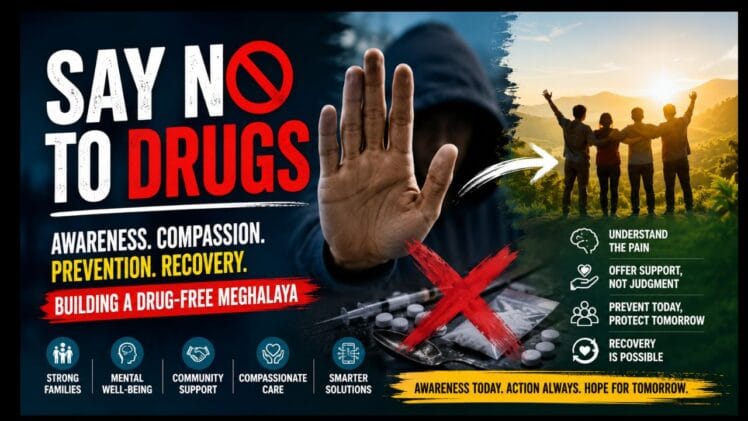
Say No to Drugs
What is International Day Against Drug Abuse and Illicit Trafficking? It is a moment to pause, to learn, and to act.
Why mark a single day for this issue? Because awareness alone doesn’t solve the problem. it is the starting point for prevention, treatment, and policy change. Every year, on June 26, communities around the world renew a commitment: to prevent addiction, to support people who suffer from it, and to dismantle the stigma that keeps them silent.
What does “raising awareness” actually mean?
It’s more than slogans. Real awareness is education which includes a clear, accurate understanding of what drugs and addiction are. Pharmacology defines a drug as a chemical that changes an organism’s functioning.
Today, we add a crucial detail, many drugs alter brain chemistry and, in doing so, change behaviour. That shift in the brain is what leads to addiction. For decades, addiction was judged as a moral failing. People were punished, shunned, or treated as criminals.
But science has changed that view – addiction is now recognized as a chronic disease of the brain. It reshapes brain circuitry and is influenced by genetics, environment, and individual experiences.
Who are the vulnerable groups?
Age matters too. Studies show initiation often begins between ages 11 and 14, with the average initiation around 12. Early exposure greatly increases the chance of later addiction. Untreated mental health issues like depression, anxiety, ADHD, bipolar traits also push some people toward substances as a form of self‑medication.
Social and family factors play a powerful role. Peer pressure, inconsistent parenting, lack of supervision, or growing up where substance use or criminal behavior are common. One of the strongest predictors is adverse childhood experiences like abuse, neglect, household substance use, parental conflict, or criminality.
“Children who accumulate multiple adverse experiences are many times more likely to use illicit drugs later in life. That’s why early detection and intervention are so important,” Dr Khonglah said.
So what does prevention look like?
According to the Psychiatrist, prevention means boosting protective factors like warm, consistent parenting, honest communication and quality family time, teaching social skills and self‑control; and building resilience through optimism, gratitude, and positive self‑belief.
“Programmes that start early in preschool and primary school to teach emotional skills, conflict resolution, and decisionmaking reduce later substance use, reduce rate of school drop outs and and improve school performance. Developmentally appropriate education for adolescents helps them recognize pressure, resist experiments, and make safer choices,” she said.
Awareness must lead to Action
This International Day Against Drug Abuse and Illicit Trafficking, let’s shift the conversation from blame to understanding. When we see someone struggling with substance use, instead of asking “Why the addiction?” let’s ask “Why the pain?” Because addiction is often a symptom of deeper suffering.
Choosing dignity over dependence, health over harm, and purpose over pain, we can build communities that prevent drug harm, treat people with respect, and restore lives.
There is no single quick fix, but there is hope. With better education, stronger prevention, improved access to treatment, reduced stigma, and smarter use of technology, we can turn the tide.
This day reminds us that awareness must lead to action. Let’s make that action compassionate, evidence‑based, and sustained.
(The writer is an intern from St. Anthony’s College – Philosophy Department)