Shillong:
It’s A Man’s Man’s Man’s World – Without diving into the lyrics of this 1966 James Brown classic, I am basing my observation on Meghalaya’s gender ratio in the political scenario on the title of the song alone.
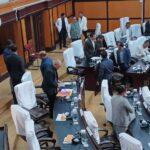
Why a man’s man’s world? The answer is simple. The facts speak for themselves. Did you know that women comprise only 6.67% of the Assembly, or 4 out of 60 MLAs as of 2025?
In 2023, Meghalaya saw 369 candidates, of whom 36 were women, a modest increase from 33 women candidates in the 2018 elections. Women registered three wins in the House of 60. They included — Dr. Mazel Ampareen Lyngdoh, Miani D. Shira and Santa Mary Shylla.
The number grew to 4 MLAs, thanks to a by-election upswing last year when Dr. Mehtab Chandee A. Sangma was sworn in as an MLA from Gambegre. Indeed, this was a modest gain, yet symbolic.
On her maiden appearance in the Assembly during the opening day of the Autumn Session on September 8, Mehtab — wife of Chief Minister Conrad K. Sangma — described the occasion as both a privilege and an honour.
Acknowledging the low representation of women in politics, she said, “I feel honoured to be a woman in this august House, and I hope that my presence here inspires more women to step into politics.”
Mehtab was elected in the Gambegre by-poll on November 27 last year, following the vacancy left by Saleng A. Sangma after his election to the Lok Sabha from Tura. Though she took oath soon after her victory, this was her first appearance in the House as she missed the previous session owing to her pregnancy.
Women Representation in Politics since 1972
1972: When Meghalaya held its first assembly elections in 1972, just one woman MLA was elected out of 60 and that MLA was Percylina Marak (APHLC) from the Rongram constituency.
1975 By-election: Miriam D. Shira successfully contested the by-election to the Songsak constituency and became the first Garo woman to be elected legislator.
1983: No woman legislator made it to the Assembly.
1988: The House saw two women MLAs — Maysalin War from Mawthengkut constituency and Miriam D. Shira from Rajabala constituency.
1993: Roshan Warjri entered the fray and became the lone woman legislator in the House of 60. She won the election from Mawkhar constituency.
1998: The number increased to three in 1998 with Roshan Warjri, Maysalin War, and Deborah C. Marak as women representatives from Mawkhar, Mawthengkut, and Rongrenggiri constituencies, respectively.
2003: The House saw two women legislators — Irin Lyngdoh from Pariong constituency and Deborah C. Marak from Rongrenggiri constituency.
2008: The number dropped to one again with Ampareen Lyngdoh emerging as the lone woman legislator. She won the election from Laitumkhrah constituency.
2013: The highest number of women representation since 1972 was recorded in 2013 with four women legislators who included — Deborah C. Marak, Ampareen Lyngdoh, Roshan Warjri and Dikkanchi D. Shira from Williamnagar, East Shillong, North Shillong and Mahendraganj constituencies, respectively.
2018: The number dropped to three in 2018. The women MLAs included – Ampareen Lyngdoh (East Shillong), Agatha Sangma (South Tura) and Dikkanchi D. Shira (Mahendraganj).
2023: The number stood at three with Dr. Mazel Ampareen Lyngdoh, Miani D. Shira and Santa Mary Shylla representing East Shillong, Ampati and Sutnga-Saipung constituencies, respectively.
2024 By-election: The number of women representatives rose to 4 MLAs in the House of 60 with the entry of Dr. Mehtab Chandee A. Sangma who won the by-election from Gambegre.
Meghalaya’s Matrilineal Culture – A Mere Symbol Of Women Empowerment
Meghalaya’s matrilineal culture – where descent and inheritance pass through women, is often hailed as a model of gender equality and women’s empowerment but this does not necessarily translate to political participation.
Notably, Meghalaya’s voter base has grown to 22,69,512 as of January 6, 2025. According to the latest electoral rolls, the state has 11,50,599 female voters and 11,18,907 male voters – reflecting a high gender ratio in the state.
As per the Special Summary Revision 2025 released by the Election Commission, the gender ratio in Meghalaya’s electoral rolls is higher than the national average, with the 2025 report showing a ratio of 1,028 women voters for every 1,000 male voters.
This trend is, however, not limited to Meghalaya. It is consistent with other Northeastern states — Manipur, Mizoram, and Arunachal Pradesh.
One would expect a high gender ratio would translate into political participation. But this is nothing more than symbolic rather than substantive.
Yes, Meghalaya is a rare bastion of gender equality but when it comes to real power – it rests with the men, as it always has – across all political spectrums – be it the Dorbar Shnong, Autonomous District Council or the Legislative Assembly.
So, all the praise Meghalaya’s matrilineal culture gets often amounts to naught when it comes to real power.
There is a Khasi adage that says, “U Rang khat-ar bor bad ka Thei shi-bor” — a man with twelve strengths, and a woman with just one. A metaphor meant to capture the differences in capability, roles, and responsibilities between genders. But it leaves me wondering: what is that one strength a woman truly holds?
In a conversation with retired IAS officer Bah Toki Blah, I was struck by his observation on women’s role in governance. He noted — and I couldn’t agree more — that the one strength a woman possesses is more than enough to ensure smooth governance: Management. After all, whether as a wife, a mother, or in countless other roles, a woman is a natural multi-tasker. Management is second nature to her.
Give her a platform, and she will shine — in the dorbar shnong, the ADCs, and even in the legislative assembly.
But until that day arrives, history leaves us with little room for doubt: politics remains, undeniably, a man’s world. Period.
Then again, I can’t help but ask these questions: Are women themselves too hesitant to contest elections? Do they still perceive politics as a man’s domain? Or is the fault embedded in our traditional and political structures that continue to sideline them? Why, after all, do political parties field so few women, and why do they rarely promote them to leadership positions?