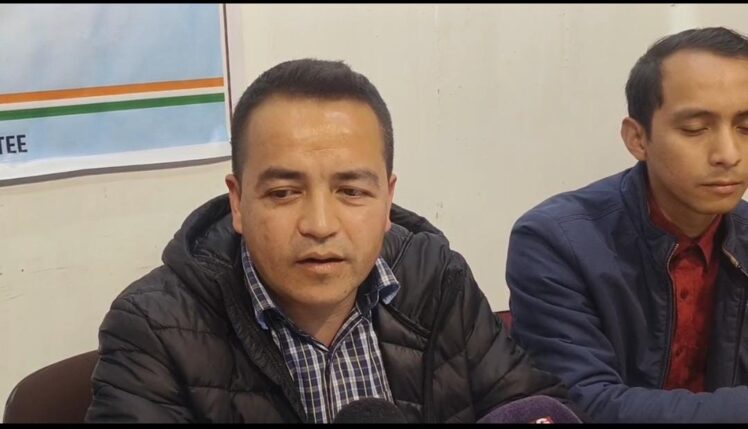
SHILLONG: The General Secretary of the Meghalaya Pradesh Congress Committee (MPCC), Manuel Badwar has criticised the Meghalaya Democratic Alliance (MDA) government, alleging that the state’s high capital expenditure is not benefiting ordinary citizens and is instead concentrated among a small group of influential beneficiaries.
Addressing the media, Badwar urged the public to examine the actual impact of the state’s economic policies on their daily lives and livelihoods.
Badwar referred to the 2025–2026 state budget, where the Chief Minister announced a capital expenditure exceeding ₹6,300 crore. While the government has highlighted this as a major achievement, Badwar questioned how effectively the funds are being utilised.
“We must ask where this money is going. If the government is investing such large sums in development projects and infrastructure, why are the benefits not reaching the common people?” he said.
Citing projects undertaken by the Public Works Department (PWD), Badwar alleged that between 2020 and 2022, around ₹760 crore was spent on various infrastructure works.
However, he claimed that a significant portion of these funds was awarded to a single group or entity, raising concerns about the fairness and transparency of the allocation process.
“This system keeps wealth concentrated among those who are already affluent, while unemployment continues to affect the wider population,” he said.
Badwar also raised questions about the effectiveness of government spending in the healthcare sector. According to him, the state government has allocated around ₹2,000 crore for healthcare in the 2025–2026 financial year, which is roughly double the amount spent in 2020.
Despite this increase, he argued that improvements in healthcare infrastructure and services remain limited.
He noted that the cost of medical treatment and medicines has reportedly increased by around 14 percent, while the number of hospital beds and overall quality of care has not improved significantly, citing observations in the Meghalaya Economic Review.
The MPCC leader also expressed concern over school dropout rates, linking them to broader socio-economic challenges faced by families.
He claimed that around 43 percent of households in Meghalaya are headed by single mothers, many of whom are forced to migrate in search of work due to limited local employment opportunities such as the MGNREGA 100-day work scheme.
According to him, this situation often leaves children without adequate support, contributing to school dropouts as they take up work to support their families.
Referring to NITI Aayog data, Badwar stated that 27.79 percent of Meghalaya’s population—approximately 9 to 10 lakh people—continue to live below the poverty line.
He warned that unless economic growth is distributed more equitably, the state could face deeper socio-economic challenges in the future.
Badwar urged the government to ensure that development initiatives genuinely benefit the wider population rather than remaining concentrated among a select few.