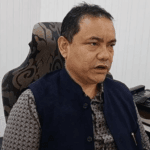
SHILLONG: Meghalaya Public Health Engineering (PHE) Minister, Marcuise N Marak, has strongly refuted media reports alleging that the state government awarded a contract worth approximately ₹1,900 crore to a Hyderabad-based company named BAC Infratech Private Limited.
Clarifying the matter, the Minister termed the allegations incorrect and stated that the PHE department follows and strictly adheres to all established guidelines and procedures during the allocation of all contracts.
Providing details on the Jal Jeevan Mission (JJM) scheme, the Minister explained that the total initial financial allocation stands at ₹6,737.49 crore. This comprehensive funding covers as many as 3,721 different individual schemes alongside initiatives to provide water supply to schools, Anganwadi centers, and various other public government departments.
The Minister emphasized that these works have been publicly distributed among various local contractors and companies who are indigenous residents of the state. He assured that the government closely monitors the entire implementation process through a dedicated Tender Committee, maintaining absolute transparency in all its operations.
This high-level committee is headed by the Commissioner Secretary of the PHE department and includes senior officials from both the Finance Department and the Law Department to oversee the proceedings, ensuring that the process remains clean and devoid of any favoritism as alleged in the news report.
While acknowledging that conducting investigations through the Right to Information (RTI) act is a positive step and noting that the government is examining the report, Marak cautioned that it is wrong to level accusations against the government without thoroughly verifying the facts.
He urged all RTI applicants to substantiate their findings and verify facts across all parameters before approaching the media. He maintained a firm stance that the PHE department has strictly followed the rules and has not shown partiality to anyone.
He further explained that major national projects such as the Jal Jeevan Mission, JICA, AMRUT 2.0, and NESIDS are executed strictly in accordance with the detailed guidelines and mandates set by the Government of India. A significant portion of these large-scale works is allotted either on a turnkey basis or under the Engineering, Procurement, and Construction (EPC) model.
Under these specific frameworks, the company that secures the tender is fully responsible for designing, executing, and completing the entire project from start to finish before officially handing it back over to the government. Because of these stringent and definitive conditions, the tender rules remain transparent and clear, leaving absolutely no room for manipulation, interference, or irregular allocations.
The Minister further clarified two distinct aspects regarding the issue, namely the share of work obtained by the company and the allegations that the government deliberately favoured it. He pointed out that these are entirely separate matters, explaining that the company secured the contract solely by passing through a competitive and rigorous bidding process in line with tender rules, rather than receiving any special favour or partiality from the government.
He described the allegations stemming from the RTI as baseless, stating that even if the physical documents themselves are official, the interpretation and presentation of the issue in the news report is incorrect. Outside companies secure these major projects because they successfully fulfill all technical requirements and possess the necessary technical expertise, execution capacity, and proper financial and administrative paperwork during the tendering stage.
The Minister stated that if local contractors met these heavy requirements, the government would gladly award the contracts to them. However, as things stand, local contractors capable of taking up massive EPC and turnkey projects are extremely rare and few in number due to the massive scale and heavy technical demands of the work. Consequently, these outside firms win the contracts purely on the merit of their own capacity and technical capability.
Marak reiterated that when managing mega-projects funded by the central government like the Jal Jeevan Mission, JICA, and AMRUT, the strict central guidelines mandate that allocations must be made using turnkey and EPC models.
The state government is legally bound to operate within this framework established by the central government, and these external companies successfully secured the work because they perfectly matched the required criteria, backed by decades of proven experience and successful project completion.