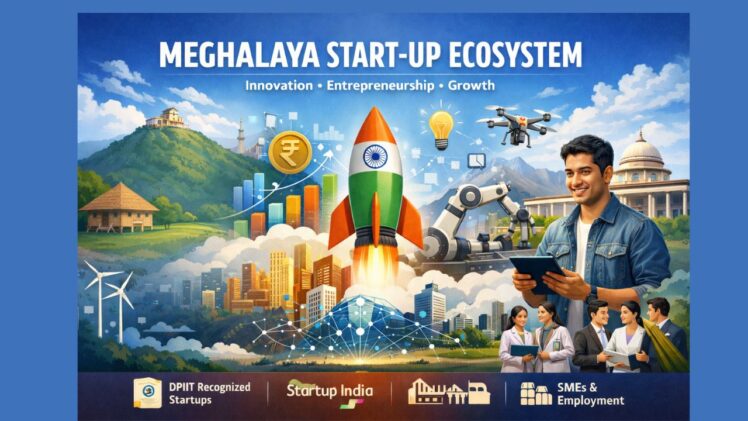
The word ‘start-up’ refers to a new business enterprise which is innovative, risk-oriented and takes advantage of the opportunity which is present in the market. The most important feature that a start-up must possess is scalability. A start-up should have the capability to scale in size with the passing of every financial year. This is measured in terms of revenue, profits, employment generated, market penetration, market expansion, etc. This means that if a start-up cannot scale itself over time, then, it is not a ‘start-up’ in the truest sense of the term.
Another element that has to be present in a start-up is the extensive use of technology and/or the development of new technology(s).A start-up may not be 100% dependent on technology. But, the ‘usage of technology’ is a critical leverage for attaining scalability. Some examples are advertisements through digital marketing, digital content creation, surveys using digital means such as online forms like Google Forms, etc. More examples, in the past there was black and grayscale printing only. Then colour printing was a start-up. Similarly, smart TVs, smart mobile phones, drone technology, AI developments, etc are all generic examples of start-ups.
The India Start-Up ecosystem
The Ministry of Commerce and Industry (Govt. of India) accelerates start-ups through Department for Promotion of Industry and Internal Trade (DPIIT). As per January, 2024 guideline, DPIIT recognised start-ups are eligible for benefits such as intellectual property rights (fast processing of start-up patent applications), relaxation in public procurement norms (start-ups can get listed as sellers on the Government of India’s largest e-procurement portal – Government e-Marketplace), self-certification under labour and environment laws (start-ups are allowed to self-certify their compliance for certain labour and environment laws for a period of 3 to 5 years from the date of incorporation), funds for start-ups (only for innovation-driven enterprises), faster exit in case of closure, seed fund scheme(financial assistance for proof of concept, prototype development, product trials, market entry, etc) and tax exemptions.
The existing legal definition of an Indian start-up is that it is a private limited company (as defined in the Companies Act, 2013) or registered as a partnership firm (under section 59 of Partnership Act, 1932) or a limited liability partnership (under the Limited Liability Partnership Act, 2008) for up to 10 years from the date of its incorporation/registration and if the turnover for any of the financial years since incorporation/registration has not exceeded Rs. 100 crores. As on January, 2024, there are more than 89000 start-ups recognised by DPIIT generating around 10 lakh jobs in sectors such as IT services, healthcare and life sciences, education, etc. The top 3 start-up leading states are Maharashtra, Karnataka and Delhi.
The Startup India platform (www.startupindia.gov.in) provides free resources (information on government schemes, idea banks, network of mentors, investors, incubators, etc) to start-ups to help navigate the competitive market. For any start-up, this is the portal to start from.
Meghalaya Start-Up picture
Many start-ups in Meghalaya are in the form of a sole proprietorship or family business. They are primarily conventional businesses which are basically a duplication of what is already being done by others. An acquaintance of this writer regularly talks about a concept called ‘good idea’ shops. What he means by that is if one person starts a business selling product A; then others just follow and also start a business selling product A. The problem with ‘good idea’ shops is that the market gets limited, revenue falls and ultimately the business fails.
Further, the nature of start-ups in Meghalaya depicts that they do not fall under the requirements for gaining recognition from DPIIT. They are not innovative and/or tech-driven. As on 27th January, 2026, the Startup India initiative of the Govt. of India lists 87 Meghalaya start-ups recognised by DPIIT with 42 women-led start-ups. If the current population of Meghalaya is taken as 35 lakhs, then it converts to ‘one start-up for every 40230 persons’. This is not encouraging at all when compared with Maharashtra which has 34000 DPIIT recognised start-ups with a state population of 13 crores. This converts to ‘one start-up for every 3824 persons’. These are the type of numbers which should challenge the start-up ecosystem of Meghalaya. Then only it would be worthy of praise.
Importance of Start-Ups
It is an established fact that any economic progress depends on entrepreneurship. Central to this is the presence of start-ups. Some of the common citations on the importance of starts-ups are that they instill a business environment of innovation, alertness and awareness of the entrepreneur, willingness to take informed risks, create new and innovative products/services, generate employment opportunities, contribute to the government exchequer, etc. In truth, start-ups do something more important. They reflect upon the enterprising character of a community. They create a sense of self-esteem and self-actualization in the entrepreneur. They contribute towards a progressive society which lives in peace and harmony. When people work then the tendency to fall into harmful addictions like drugs and alcohol reduces.
As such, any government that focuses on entrepreneurship and particularly start-ups can be considered as a visionary government. However, the problem lies in the limited number of small and medium enterprises (SMEs). SMEs are important as they have the tendency to employ a larger number of people. In Meghalaya, the majority are sole proprietorship which employ a few only. On the other hand, there is not much scope for big corporate. Hence, SMEs are basically what can be termed as the missing-link. If start-ups are to be viewed from the context of start-up India and recognized by DPIIT, then they have to be incorporated and function as a SME. This is the real issue facing business and development in Meghalaya. Unless a corrective course is mapped out, the problem of unemployment, youth restlessness, rich-poor income disparity, etc shall continue.
(The writer is an Associate Professor at the North-Eastern Hill University -NEHU. He can be reached at email – benjamin@nehu.ac.in)
The opinions expressed in this publication are those of the author. They do not purport to reflect the opinions or views of 4Front Media or its members.