SHILLONG: Government, technical institutions and development partners come together to map embodied carbon and explore climate-responsive construction
As Shillong prepares for continued urban growth, the city has begun examining an often-overlooked dimension of development—the carbon embedded in the buildings and infrastructure it constructs.
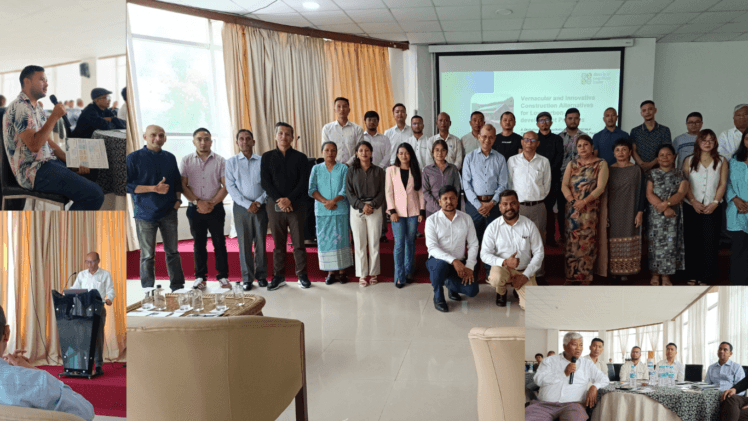
A workshop on “City-Scale Embodied Carbon Mapping” was held today at the State Convention Centre, Shillong, bringing together the Department of Urban Affairs, Government of Meghalaya, technical experts, development institutions and stakeholders from across the urban development ecosystem to explore how future construction in Shillong can become more resource-efficient, locally appropriate and climate-responsive.
The workshop was organised in the context of Project VICALP – Vernacular and Innovative Construction Alternatives for Low-carbon Development Practices, an initiative of the Alliance for an Energy Efficient Economy (AEEE) in collaboration with IIT Bombay and Barefoot Trust, with the engagement of the Department of Urban Affairs, Government of Meghalaya.
Over the past two years, the collaboration has included ward surveys, building assessments, analysing Bills of Quantities, site visits and assessments of diverse building typologies across Shillong—from heritage structures such as the 125-year-old Bishop Kuti to institutional buildings at NEHU & Dinet Manik Syiem School.
The initiative comes at a significant moment for Shillong.
The city’s built-up area was estimated at 14.3 million square metres in 2023 and is projected to reach 20.4 million square metres by 2070.
With every new building potentially locking in emissions through its materials and construction for decades, the question is no longer only how much energy a building consumes during its lifetime, but also how much carbon is already embedded in the building before it begins to operate.
“These are not distant projections; they are important signals for how cities need to plan for future growth.” (Shri B.R.M. Lyngdoh, Joint Director, Urban Affairs, Government of Meghalaya)
From individual buildings to the city as a system
The workshop showcased a City-Scale Embodied Carbon Assessment Tool, developed in collaboration with IIT Bombay, which enables planners and stakeholders to examine the carbon implications of different material choices, development densities and future growth scenarios before construction decisions are made.
The workshop also featured discussions on bottom-up modelling of Shillong’s building stock, embodied-carbon baselining, low-carbon material choices and pathways for carbon abatement, followed by a demonstration of the city-scale tool
A Low-Carbon Materials Directory developed through the initiative is another component intended to bridge the gap between knowledge and implementation by connecting architects, engineers, developers, contractors and government stakeholders with lower-carbon material alternatives.
The initiative also seeks to examine how vernacular construction practices and locally appropriate materials can contribute to Shillong’s climate response. AEEE Speech VICALP
Dr. Satish Kumar, President and Executive Director, Alliance for an Energy Efficient Economy (AEEE) emphasised that Shillong’s building sector needs to accelerate the adoption of sustainable, low-carbon, cost-effective and scalable construction practices to respond to growing infrastructure needs while reducing environmental impacts.
He also highlighted that mainstreaming innovative materials such as Bambocrete can provide a promising pathway towards greener construction. Developing local manufacturing and supply chains for such materials can help meet Shillong’s growing demand, reduce transportation-related emissions and costs, create local employment, and strengthen the region’s capacity for sustainable construction.
Scaling locally produced, innovative building materials can therefore play an important role in making Shillong’s built environment more resilient, affordable and low-carbon.
A cross-sector approach to Shillong’s future
The workshop saw engagement from a wide range of institutions connected to Shillong’s development—including the Public Works Department (Building), Department of Tourism, Directorate of Health Services, Sports Department, Directorate of School Education and Literacy, Housing Department, Meghalaya Urban Development Authority (MUDA), Shillong Municipal Board, Shillong Smart City Limited, Meghalaya State Rural Livelihoods Society (MSRLS), Meghalaya State Skill Development Society (MSSDS), Smart Village Movement & Shillong Smart City Limited and Meghalaya Architects Forum.
Their involvement is significant because the carbon footprint of a city is not created by the construction sector alone. Schools, hospitals, housing, tourism infrastructure, sports facilities, public buildings, roads, municipal infrastructure and new urban developments all contribute to the physical form and resource requirements of a growing city.
“I wish for a cleaner and greener Shillong as we can clearly perceive the difference between the rural areas and the urban setups. Sometimes, I just go out into the countryside to experience the change”(A Participant)
The participation of institutions working across urban planning, housing, public infrastructure, education, health, tourism, livelihoods and skills therefore creates an opportunity to take the conversation beyond individual green buildings towards a more integrated approach to urban development.
Project VICALP adds another important dimension to this emerging conversation: whether the places we make smarter can also become materially and environmentally more responsible.
The objective is therefore not simply to introduce new technologies or materials, but to build better decision-making systems—where planners, government departments, researchers, construction professionals, material suppliers and communities can understand the long-term implications of today’s development choices.
From data to decisions
A central focus of the workshop was to explore how the tools and research generated through VICALP can move towards practical application.
The workshop provided an opportunity for government officials, technical experts, industry stakeholders and practitioners to validate the tools, provide feedback, identify pathways for adoption and strengthen the demand-and-supply ecosystem for low-carbon construction. AEEE Speech VICALP
This is particularly relevant for a city such as Shillong, where construction decisions are shaped not only by conventional engineering and economic considerations but also by terrain, rainfall, local climatic conditions, material availability, heritage, traditional construction knowledge and the pressures of rapid urbanisation.
Building a local ecosystem for low-carbon construction
Rather than viewing embodied carbon solely as a technical or environmental issue, the initiative seeks to open a broader conversation around the future construction economy of Meghalaya.
A transition towards lower-carbon construction could have implications for material suppliers, local enterprises, skilled workers, architects, engineers, contractors and training institutions.
This makes the involvement of institutions such as MSSDS and MSRLS particularly relevant to the longer-term question of developing local skills, enterprises and supply chains alongside new construction practices.
Similarly, the involvement of departments dealing with tourism, health, education, housing and public infrastructure creates possibilities for demonstrating how low-carbon principles can be incorporated into different categories of buildings and public infrastructure.
For Shillong, the larger question emerging from the workshop is therefore not simply how to construct a low-carbon building, but:
“How can Shillong grow without locking itself into the carbon-intensive construction patterns of the past is the challenge for us?” (Dr. Brijesh Pandey, Principal Research Associate, AEEE)
Project VICALP seeks to contribute evidence, tools and locally relevant alternatives to help answer that question.
The workshop concluded with a focus on strengthening collaboration between government, research institutions, practitioners and the construction ecosystem, with the larger objective of making low-carbon and climate-responsive development a practical part of Shillong’s future urban planning and construction decisions.
(4FrontMedia news)