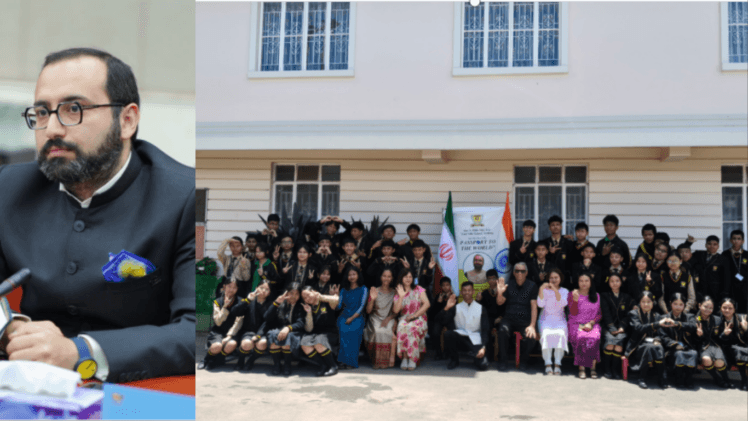
SHILLONG: In a significant milestone for youth diplomacy and international exposure in the region, Mrs. N. Hill’s Tiny Tots East Ville Secondary School hosted the second event of its “Passport to the World” international learning series.
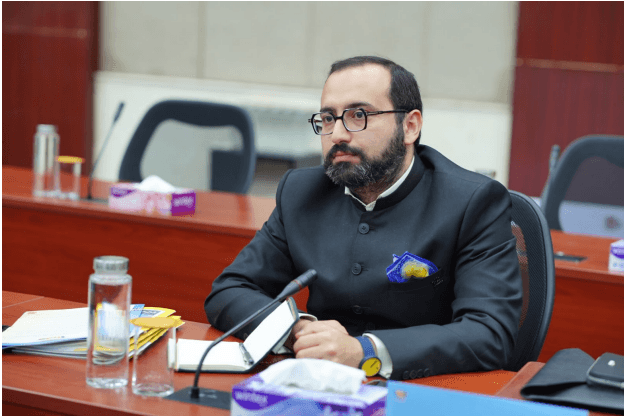
Students engaged in an in-depth virtual dialogue with Dr. Omid Babelian, Second Secretary and Representative of the Institute for Political and International Studies (IPIS) at the Embassy of the Islamic Republic of Iran in New Delhi.
Coordinated by Cleric Jayden Wanniang, the session drew 45 students—surpassing the turnout of the school’s previous session with the Embassy of Spain.
Registrations came from a variety of Shillong institutions, including MIT Meghalaya, St. Anthony’s College, BSF Secondary School, and Lady Keane College, reflecting strong interest in global affairs among the city’s youth.
The interaction spanned topics of global diplomacy, West Asian geopolitics, regional security, multilateralism, and the historical ties between India and Iran.
Diplomacy Rooted in Dialogue and Resilience
Opening the discussion, Dr. Babelian outlined Iran’s foreign policy, which he said rests on two core principles: dialogue and resilience. He drew parallels with ancient Indian literature, noting that Iran’s diplomatic strategy is inspired by the wisdom found in texts like the Mahabharata. Dr. Babelian emphasized Iran’s openness to peaceful, constructive dialogue and highlighted the country’s enduring unity and diversity—across communities of Muslims, Christians, Jews, and others—as a foundation of “civilian deterrence” and national strength.
Strategic Research and Regional Dynamics
Responding to questions on policy formulation, Dr. Babelian described the Institute for Political and International Studies (IPIS) as a bridge between formal diplomatic missions and academic, grassroots realities. He discussed Iran’s commitment to multilateral diplomacy and its participation in frameworks such as the 2015 Joint Comprehensive Plan of Action (JCPOA), explaining that setbacks were often due to unilateral actions by other parties.
He also touched on Iran’s defensive posture in the Persian Gulf, clarifying that it is directed at foreign military deployments, not neighboring states. The role of multilateral organizations like BRICS and the Shanghai Cooperation Organisation (SCO) was highlighted, with Dr. Babelian noting their importance in empowering Global South nations to pursue independent partnerships and resolve disputes.
Student Q&A: Diplomacy, Sovereignty, and Career Advice
During the Q&A session, students explored a range of diplomatic topics:
Career Insights: Magrasiomi G. Lyngdoh (Class 10) asked about building a career in diplomacy. Dr. Babelian advised that being a diplomat requires global engagement and an open mind.
Balancing Relations: Wanphira B. Wahlang (Class 9) asked about India’s dual relations with both Iran and Israel. Dr. Babelian responded that Iran respects the sovereign foreign policy choices of other nations and seeks mutual respect for strategic autonomy.
A Message to Youth: Curiosity and Building Bridges
Dr. Babelian encouraged students to be curious, read widely, and seek truth beyond mainstream news. He invited them to explore Iranian culture, literature, and cuisine, emphasizing that diplomacy’s vital task is “building lasting bridges between civilizations and nations.”
School Remarks and Cultural Engagement
Academic Supervisor Miss Bala Syiem praised the “Passport to the World” initiative for bringing firsthand global perspectives to Shillong’s youth, describing the session with Dr. Babelian as a fruitful exploration of West Asian and Global South relations.
The event concluded with a Postcard Writing Session, where students crafted messages to the Iranian Embassy, deepening their international engagement. Coordinator Cleric Jayden Wanniang committed to bringing more high-level international educational programs to the school.
(4FrontMedia news)
ALSO READ: A Touch of Spain in Shillong Classrooms