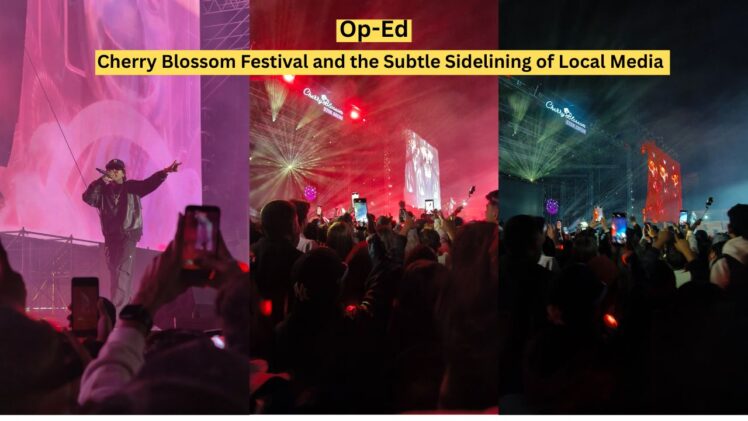
SHILLONG: The impulse for writing this piece does not arise from confrontation. It arises from a conversation—an honest, weary confession by a young journalist who had returned defeated from the opening of this year’s Cherry Blossom Festival. Her words lingered long after she spoke to them, carrying both disappointment and a deeper warning about how the culture of public events in Shillong is quietly changing.
“They didn’t allow press people to move anywhere,” she said. “We had to sit in one corner, and filming with a phone wasn’t nice. They gave out passes as if they were doing us a favour, but they just made us sit in a corner… I’m fed up.”
Her frustration, as I realised, was not about discomfort. It was about being denied the ability to do her job. About being placed in a position that stripped the press of its basic dignity, its professional space, and its purpose. Covering an event requires movement, observation, access—the possibility to see things up close, catch the small moments, and read the energy of a performance. To be restricted to a distant enclosure is to be silenced in plain sight.
And this discontent is not isolated. It reflects an unsettling shift in how certain major events in Meghalaya are beginning to treat the local media—selectively, reluctantly, and at times, dismissively.
There was a time when Shillong’s events—whether modest gatherings or major concerts—were built on a relationship of trust between organisers and the media. I grew up watching concerts like Blood and Thunder and Great Society unfold with ease, openness, and mutual respect. Later, when the press fraternity became a central force in the city’s cultural life, international artistes arrived with genuine excitement to meet local journalists. Pre-event press briefings were rituals, not formalities. Musicians from MLTR, Scorpions, Fire House, Pandit Hari Prasad Chaurasia, and even Shillong’s own Amit Paul spoke eagerly to the local press.
Those interactions mattered. They created a bond between performers and the city. They allowed journalists to craft stories that captured not just the music, but the cultural moment. Mainstream, independent media—before the age of influencers and curated optics—gave Shillong its reputation as a serious, sincere, culturally vibrant destination. They documented its growth, its transformation, its rhythm.
But somewhere along the way, something shifted.
The present-day model of certain events—especially the Cherry Blossom Festival—reveals a growing discomfort with the idea of an independent press. There is a visible preference for curated optics, handpicked “guest media,” and social media influencers. This might appear harmless, even modern, but it is neither harmless nor modern. It is simply exclusion dressed in new vocabulary.
Not long ago, another senior journalist recalled his own experience at a major event in the city—the Bryan Adams concert. Despite holding a media wristband, he and several others were directed to the distant northern stand of the JN Sports Complex. Equipment-heavy photographers and feature writers were made to walk long stretches only to be placed so far from the stage that the performer was little more than a moving silhouette on giant screens. Meaningful coverage was virtually impossible. He remembered feeling insulted—not because he was far away, but because the profession he represented had been reduced to a logistical inconvenience.
That memory resurfaced sharply this year when the Cherry Blossom Festival’s “guest media” passes emerged. These passes, issued to a handpicked and unexplained group, granted expansive access—from fan pits and FOH to backstage and VIP lounges. Meanwhile, local journalists were constrained to fixed corners with minimal movement. Even two senior feature writers from Hindustan Times, who had travelled to Shillong at their own expense, could not obtain media passes. They were forced to buy tickets.
It is worth asking: What criteria allow someone to roam freely backstage, while seasoned journalists are confined to corners? Who decides? And why must it be shrouded in secrecy?
The irony in all this is almost tragic. Shillong does not need manufactured publicity. It does not need influencers to “validate” it. This city has long been a cultural, musical, intellectual destination. It has always had a pulse, a reputation, a character—born not from curated content but from lived experiences, genuine talent, and decades of rich storytelling.
Events like the Cherry Blossom Festival have benefited immensely from local media coverage—not because they demanded it, but because journalists in Shillong care deeply about the city. Year after year, despite restrictions and logistical inconveniences, the press has shown up. They have documented, amplified, and celebrated the city’s cultural life—not out of obligation but out of affection. But every community, every profession, has limits.
If these trends continue, the consequences will be felt far beyond the media fraternity. As local journalists grow weary, stories will shrink, features will disappear, and reportage—the kind that gives events longevity, credibility, and archival value—will fade. Influencer videos last a day. A thoughtful feature lasts years. A well-written article becomes part of collective memory. Replace independent media with curated content, and what you gain in instant visibility, you lose in legacy.
This is not merely a matter of passes or zones. It is a matter of respect. It is a matter of recognising the role of the press as a democratic institution, not an accessory to be summoned or sidelined at convenience.
This piece is not an attack on any organiser or department. It is a call for reflection. A city like Shillong thrives on community spirit. Its festivals are not just spectacles—they are shared experiences that knit together artists, audiences, entrepreneurs, and storytellers. To exclude the press is to exclude the very people who help translate these moments into lasting public memory.
The government, whether directly involved or not, cannot wash its hands of responsibility. If public spaces, permissions, and official machinery are part of an event’s ecosystem, then accountability must follow. Facilitation without responsibility is simply abdication.
Let us not wait for the quiet murmurs of today to turn into a silence that everyone notices too late. The media is not asking for privilege. It is asking for dignity, for access, for the simple ability to do its job.
A city that sidelines its storytellers eventually loses its story.
And Shillong deserves better than that.
(This Opinion Piece was written by a senior journalist from Meghalaya who do not wish to be named)