SHILLONG: The Jaintia Coal Owners, Miners, Suppliers, and Workers Association (JCOMSWA) has decided to press ahead with its indefinite hunger strike, which has now entered its 17th day.
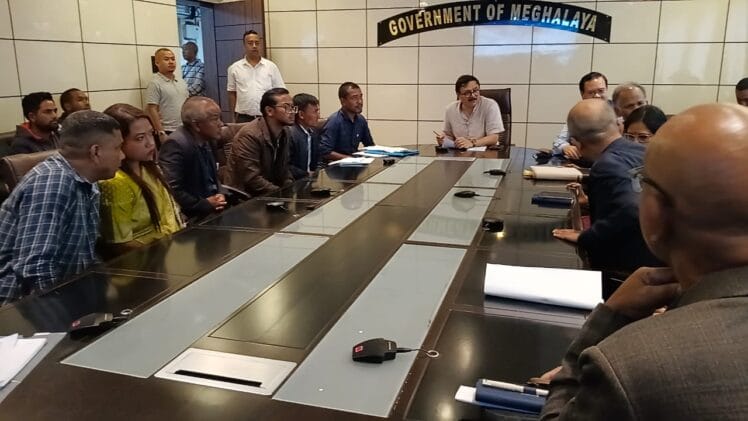
This decision to continue the agitation was finalized after a high-stakes meeting between association members and state Chief Secretary Shakil P. Ahamed failed to yield a mutually satisfying resolution to the ongoing impasse.
Despite the deadlock on core demands, the meeting did produce a few key administrative decisions.
According to JCOMSWA Information Secretary Overcome Dkhar, the state government has agreed to constitute a dedicated Mining Committee.
This body, which will include the Deputy Commissioner of East Jaintia Hills alongside representatives from the association, is being tasked with drafting a small-scale mining policy.
In another temporary concession, the state government has agreed to suspend the transportation and import of coal from outside Meghalaya until retired Chief Justice B.P. Katakey visits East Jaintia Hills on June 29, 2026.
Furthermore, the government announced the rollout of financial assistance schemes designed to support individuals whose livelihoods have been derailed by the coal mining ban.
These relief measures will be funded through the Meghalaya Environment Protection and Restoration Fund (MEPRF) and will operate directly through the Deputy Commissioner’s office.
Additionally, the state administration has promised to initiate talks with the Jaintia Hills Autonomous District Council (JHADC) to frame specific laws governing sub-surface minerals.
However, these structural developments fell short of satisfying the association. JCOMSWA expressed deep frustration over the timeline, noting that the government cannot hold a follow-up meeting or make definitive rulings until after the retired Chief Justice concludes his upcoming inspection.
The association maintained that the protest will continue unabated because their primary demands have not been met.
They also highlighted the escalating stakes of the protest, noting that their President is currently hospitalized due to the strike, yet members remain resolute in continuing the fast until Justice Katakey arrives. The association is standing firm on its ultimate demand, which is the complete lifting of the ban on coal mining.
Elaborating on the dialogue, association member Wanshwa Nongtdu explained that the delegation successfully presented several critical agendas and submitted a formal memorandum during the meeting.
While this presentation successfully paved the way for JCOMSWA’s inclusion in the upcoming small mining policy committee, a major policy hurdle remains. Nongtdu pointed out that while the government has permitted “scientific mining,” the current policy mandates a strict baseline clause requiring a minimum contiguous land area of 100 hectares.
This requirement poses an insurmountable barrier for local residents who simply do not own or have access to such vast, continuous tracts of land. The association is vehemently demanding that the government drastically reduce this mandated land area.
While the state’s Mining Department and legal team urged patience and cooperation, they stated they could not issue any dynamic, on-the-spot legal rulings and must await the Chief Justice’s June 29 visit before scheduling the next round of official talks.
In the interim, officials reiterated that struggling locals should apply for financial relief through the MEPRF.
Ultimately, the delegation made it clear that they walked out of the meeting deeply unsatisfied.
The association expressed immense frustration that the government failed to provide reassuring commitments on the majority of the agendas they brought to the table. As a result, they have vowed to sustain their agitation until they receive a solid, written assurance regarding a feasible and realistic small-scale mining plan.
Association leaders further explained that the 100-hectare rule is entirely impractical for Meghalaya’s unique topography. In this region, miners must dig deep vertical shafts ranging from 100 to 200 meters just to reach the coal seams, they explained.
Commercial coal mining originally commenced in the state in 1984 in the Wahpung area and continued uninterrupted for three decades until 2014, when the National Green Tribunal (NGT) stepped in to impose a blanket ban.
Association members argued that their traditional mining methods had historically caused no major problems, maintaining that the abrupt ban is the direct driver of the severe economic hardships plaguing local residents today.