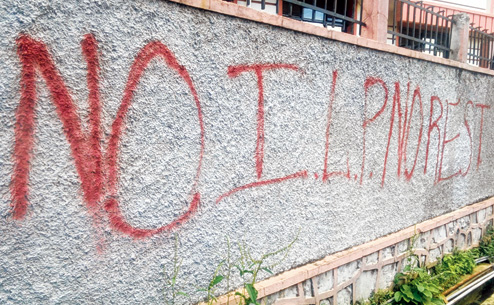
SHILLONG: The Khasi Students’ Union (KSU) has strongly criticised the Meghalaya Government, accusing it of repeatedly rebranding legislation instead of effectively addressing illegal immigration and border regulation in the state.
Addressing the media, KSU President Lambokstarwell Marngar launched a sharp attack on what he described as the government’s ongoing “name-changing exercise,” alleging that successive policies have failed to deliver real protection for indigenous communities.
Marngar stated that the Meghalaya Residents Safety and Security Act (MRSSA), introduced during the tenure of former Chief Minister Dr. Mukul Sangma, was projected as an alternative mechanism to the long-demanded Inner Line Permit (ILP) system.
According to the KSU, despite provisions for setting up check-gates and involving local Dorbar Shnongs in monitoring residents, the Act has largely remained ineffective due to poor enforcement.
The KSU President further pointed out that the Meghalaya Legislative Assembly had unanimously passed a resolution in 2019 seeking implementation of the ILP in the state. However, the proposal continues to remain pending with the Central Government, with no major progress reported even after several years.
Confusion Over ‘ILP-Like’ Proposal
Expressing frustration over the government’s latest proposal of introducing an “ILP-Like” system in 2026, Marngar questioned the rationale behind repeatedly introducing new terminology without strengthening enforcement mechanisms.
“We no longer understand this constant name-changing every few years,” he said, alleging that such moves create confusion among citizens while failing to address ground realities.
He added that if the government is genuinely committed to safeguarding Meghalaya, priority should be given to strict implementation of existing laws rather than introducing new labels.
The KSU maintained that the security of indigenous communities must not be compromised through political rhetoric or administrative delays.
The union has demanded immediate and rigorous enforcement of existing regulatory mechanisms, stressing that meaningful action—not policy rebranding—is essential to tackle illegal immigration and ensure long-term protection of the state’s demographic interests.