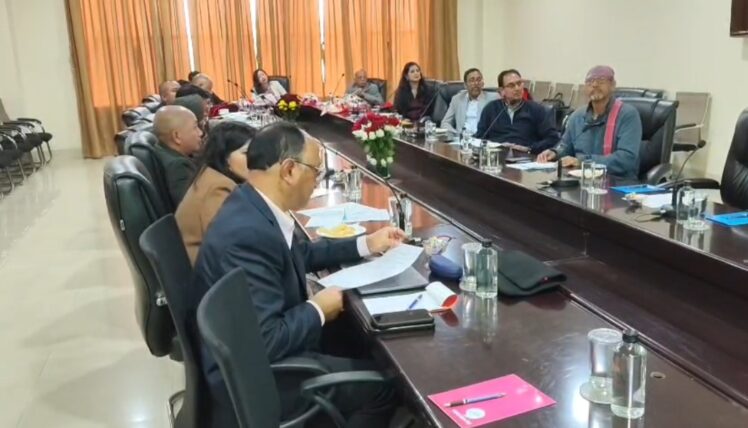
SHILLONG: A day-long Second Stakeholder Consultation Meeting on the Himalayan Agroecology Initiative was held on Friday at the State Convention Centre in Shillong, bringing together policymakers, agricultural experts and representatives from various national and international organisations to deliberate on strengthening sustainable agriculture in the Himalayan region.
The consultation was organised in collaboration with the World Future Council, IFOAM – Organics International, the Alliance of Bioversity International and CIAT, and the United Nations Development Programme (UNDP).
The meeting focused on finalising the Himalayan Agroecology Roadmap for Sustainable Food Systems in the Indian Himalayan Region, while also seeking to strengthen agroecological policies in Meghalaya through dialogue, knowledge exchange and cooperation among stakeholders.
Addressing the gathering, Secretary of Agriculture, Government of Meghalaya, Isawanda Laloo, highlighted the importance of promoting sustainable and climate-resilient agricultural practices in the region.
She described the consultation as a valuable learning platform, stressing the importance of open discussions among stakeholders to exchange ideas, raise concerns and collectively explore solutions to common challenges faced by farmers.
Laloo also acknowledged the presenters for clearly outlining the objectives and scope of the initiative.
Placing the discussion within a broader global context, she noted that debates on climate change and carbon emissions continue worldwide even as global conflicts and environmental degradation dominate international discourse. Despite these contradictions, she said such forums remain vital as they enable stakeholders to reflect on local challenges within a global framework and identify ways to support vulnerable communities, particularly farmers who form the backbone of the food system.
The Agriculture Secretary also pointed out several challenges confronting the agricultural sector, including growing market dependence, the persistence of traditional farming practices, limited access to extension services and technology, and inadequate information among farmers.
She emphasised the need for stronger support mechanisms to ensure that farmers receive assistance where it is needed most.
Highlighting the importance of academic collaboration, Laloo said that although Meghalaya does not have a dedicated agricultural university, institutions such as the Central Agricultural University and the College of Post-Graduate Studies in Agricultural Sciences play a crucial role in research, knowledge dissemination and the development of improved farming techniques.
She further stressed that agricultural policies and programmes must be more localised and aligned with regional realities. Direct engagement with farmers and grassroots practitioners, she added, is essential for better understanding their needs and challenges.
Among those present at the consultation were S. V. Nagachan, Jai C. Rana, Maqbool Lyngdoh, R. Nainamalai, Anupam Mishra and Sonal Dsouza, along with participants from various government departments and organisations.
The consultation concluded with stakeholders exploring strategies to strengthen sustainable agriculture and build resilient food systems across the Himalayan region.