SHILLONG:
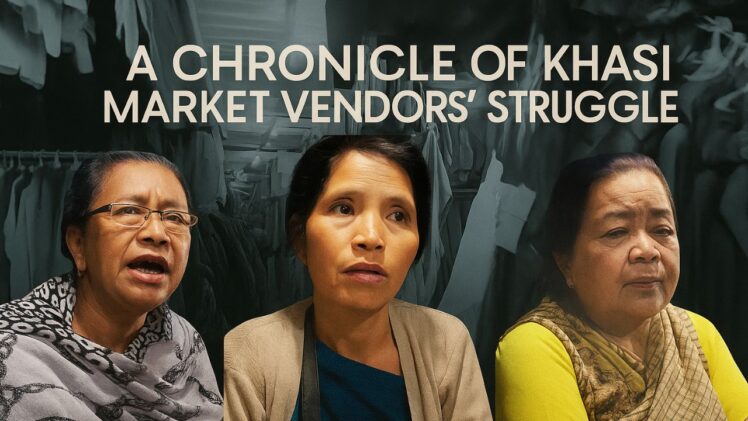
The bustling streets of Shillong tell a story of a city in constant flux, but for the street vendors of Khasi Market, this flux has become a cycle of displacement and despair. Their story is a powerful microcosm of the challenges faced by informal economies in the wake of ambitious urban development projects, where the promise of progress often comes at the expense of livelihoods and tradition. For two years, a community of 86 families has been living a precarious existence, waiting for a promise to be fulfilled, a promise that feels increasingly distant.
Their struggle traces back to 2014, when the iconic Motphran bridge was deemed unsafe and demolished. This was a turning point. The vendors who had long operated on and around the bridge were relocated to a temporary space at the Motphran parking lot. This move, initially disruptive, eventually became a new normal. The area, though a parking lot, was a vital artery of the city, and foot traffic from the nearby Iewduh, one of Asia’s largest and oldest markets, ensured a steady flow of customers. The vendors adapted, their stalls of second-hand clothes, became a familiar and beloved part of the landscape. They thrived, building not just businesses but a community. “We never even had time to eat,” one vendor recalled, speaking of the days when business was so good. It was here that many of them, like the one vendor who proudly mentioned it, were able to send their children to school and build a future.
But the temporary nature of their existence was once again brought to the forefront. In an effort to modernise the city under the “Smart City” initiative, the government announced plans to construct a multi-level car parking facility at the Motphran site. This was a major project, and the vendors were told they would have to move again. This time, their temporary home was to be the Pahsyntiew Parking Lot in Garikhana. The move was jarring, the vendors felt but they trusted the government’s word. They were told the construction would be swift, a mere 10 to 12 months, after which they would be welcomed back to a new and improved facility.
Two years have now passed, and the vendors’ trust has been tested to its limits. The promised construction has barely begun, with one vendor noting with bitter irony, “we don’t even see one pillar that has been erected.” This stark lack of progress has been a source of immense frustration. The Synjuk jong ki nongdie jaiñ, their association, has been a persistent voice in their fight, repeatedly attempting to meet with authorities. Their recent meeting with the CEO of the Shillong Municipal Board was a moment of fleeting hope, as they were given a new, yet another, deadline: January. But as one of the vendors, a veteran of these displacements, observed, “the way I see it now, I doubt it because there has been no progress.”
ALSO WATCH RELATED VIDEO IN KHASI
They observe that this move to Garikhana has been nothing short of a catastrophe for their businesses. The location is far from the city’s commercial heart, a remote and hidden spot that lacks the visibility of their previous home. “There are no customers because the place is far from the main market,” a vendor explained. The clientele they once depended on, passersby and casual shoppers, have evaporated. They are now reliant on a small pool of friends and loyal acquaintances, a base too small to sustain 86 families. “Each of us here are members of 86 families that we have to feed,” a vendor emphasised, highlighting the dire human consequences of this neglect. They spoke of accumulating debts, of clothes they can’t sell, and of suppliers who have stopped providing them with goods. The informal economy they are part of is built on trust and a quick turnover of goods, and both have been shattered by this prolonged uncertainty.
Beyond the financial strain, the physical conditions of their current location are “deplorable”. They are crammed into a small space with low corrugated metal sheets that amplify the scorching heat of the summer sun, the vendors lamented adding, “We have only one window and on top of that we have a tin roof that is very low. The lack of proper ventilation and space is a health hazard, a grim reality they must endure day in and day out.”
Their story is one of unshakeable faith and a quiet dignity in the face of adversity. “We always cooperated and never protested like others because we do not want to lose our respect,” one vendor stated. This sentiment is rooted in their deep religious convictions, with many being fellow believers who choose prayer over protest. But even faith has its limits. They have seen their livelihoods dwindle, their hopes for a stable future for their children fade, and their hard-earned reputation for quality goods questioned. The vendors are forced to sell their best clothes at a loss, just to make a sale, while the cost of business continues to rise with new taxes like GST, they stated.
The vendors’ narrative is a poignant reminder of the disconnect between grand urban plans and the lived realities of the people they impact. While the government’s intentions to create “smart” cities may be noble, the execution has been marked by apathy and delay. The vendors’ plea to the Minister of Urban Affairs is not just for a quicker construction, but a call for recognition of their plight, a plea for the city to remember the people who make its markets vibrant. They simply want to go back to their original spot, a place that was more than just a location; it was their home, their livelihood, and the foundation of their community. Will their patience be rewarded, or will the promise of a G+3 building remain an empty one, leaving them stranded on a bridge to nowhere?
Edited by Marbamonlang Rani