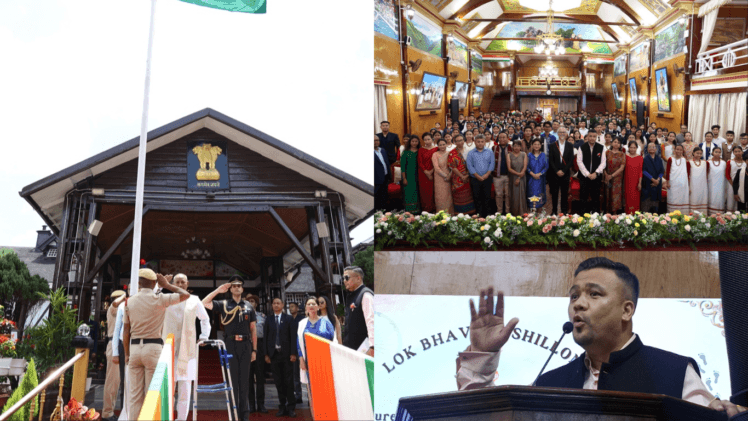
SHILLONG: Lok Bhavan Shillong, in collaboration with the Arts and Culture Department, Government of Meghalaya, observed Partition Horrors Remembrance Day on Friday to honour the victims and survivors of the 1947 Partition of India.
The programme began with the hoisting of the National Flag by Governor C.H. Vijayashankar, joined by the Director of the Arts and Culture Department, government officials, students, and invited guests.
Following the flag-hoisting, attendees gathered in the Durbar Hall for cultural performances by students, culminating in an address reflecting on the human cost and lasting impact of Partition.
Delivering the keynote, Dr. David Arnold Kharchandy, Assistant Professor at Synod College, emphasized that Partition should not be seen solely as a political event marking the end of British rule and the birth of India and Pakistan. He reminded the audience that, for millions, Partition meant the loss of homes, separation of families, disruption of communities, and the start of uncertain journeys into the unknown.
Dr. Kharchandy noted that maps depicting Partition cannot convey the depth of human suffering involved—mothers carrying children for days, elders leaving lifelong homes, and families crowded into trains with no assurance of safety. He stressed the importance of remembering Partition as a human tragedy, not just a historical statistic or boundary.
He spoke about the mass displacement of Hindus, Muslims, and Sikhs, the breakdown of once-cohesive communities, and the violence, abductions, and destruction that marked the era. Special attention was drawn to the plight of women and children, many of whom were separated from families or fell victim to violence during the migration.
ALSO READ: Shillong Tibetans Seek Accountability Over China Policy
Dr. Kharchandy warned against framing the suffering of Partition as a contest between communities, asserting that pain and loss were shared by people of all backgrounds. He cautioned that reducing the tragedy to “our people versus their people” risks obscuring the real lessons of history for future generations.
Encouraging students to imagine themselves as refugees in 1947, he highlighted the resilience required to rebuild lives from scratch in unfamiliar lands. He reminded the gathering that Partition’s consequences were deeply felt in Meghalaya and the Northeast, with altered migration patterns, disrupted trade routes, and communities divided by new borders following the creation of Bangladesh.
“Partition is not just the story of Delhi, Punjab, or Bengal—it’s part of the Northeast’s history too,” he said, urging students to explore regional experiences of Partition.
Dr. Kharchandy outlined five responsibilities for students: remember, learn, question, respect, and build. He called on them to honour the memory of Partition’s victims and survivors, study history from diverse perspectives, question rumours and stereotypes, respect people of all backgrounds, and strive to build a society where differences do not lead to hatred.
Concluding his address, he told students: “You did not create the history of 1947, but you are responsible for the history your generation will leave behind.”
He emphasized that India’s future depends not only on securing borders, but also on upholding democracy, diversity, constitutional values, and humanity.
The observance served as a powerful reminder of Partition’s immense human cost and the responsibility of younger generations to learn from history and work towards a more inclusive and peaceful society.
(4FrontMedia news)